IndustryWater, wastewater and grid networks
Edge AI Video Intelligence for Utilities
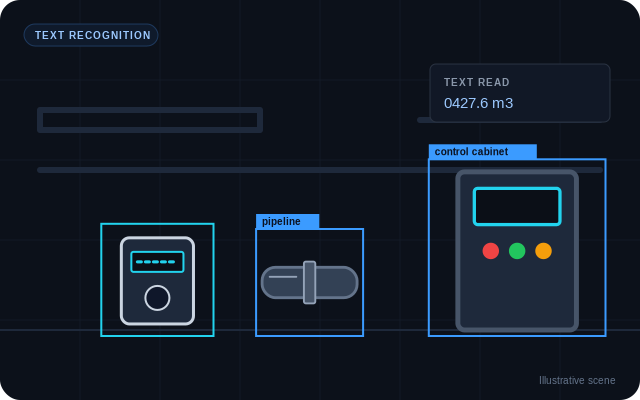
Utilities run distributed networks of treatment plants, pumping stations, reservoirs and grid assets, often unmanned. Edge AI video intelligence can support site security, equipment monitoring and visual inspection where staff cannot be present continuously.
Common challenges
- Many sites are unmanned and visited only periodically.
- Intrusion, vandalism and tampering at remote sites are noticed late.
- Analog gauges and visual indicators are still read manually in many facilities.
- Bandwidth at remote stations is often limited.
Typical visual sources
- Fixed IP and PTZ cameras at stations, reservoirs and substations
- Thermal cameras on electrical equipment
- Drones for inspecting lines, embankments and large assets
Potential applications
Unmanned site security
Detect people or vehicles at fences, gates and buildings outside expected visiting times.
Gauge and indicator reading
Read analog gauges, level indicators or status lights where retrofitting sensors is impractical.
Visual condition monitoring
Flag visible leaks, overflows, debris or damage for operations teams to review.
Network asset inspection
Analyze drone footage of lines, poles and embankments to prioritize field inspections.
Seeing distributed networks
Utilities depend on assets spread across cities and regions. Cameras at these sites are often used only after an incident. Edge AI video intelligence can turn them into continuous, local monitoring: who is at the gate, whether a gauge is in range, whether water is visible where it should not be.
Edge-first for critical infrastructure
Processing on site keeps footage inside the utility’s network and reduces dependence on limited links. Findings can be forwarded to SCADA or operations dashboards as events, with Cloud services added only if policy and requirements allow.
Questions to answer early
- Which sites and events matter most for operations and security?
- Which instruments are read manually today, and how often?
- What data-residency and security rules apply to video from these sites?
Limitations & scope
- Reading gauges from video depends on resolution, angle, glare and dial design; results are validated per instrument.
- Video monitoring complements, and does not replace, SCADA alarms and operational telemetry.
- Critical infrastructure security requirements may restrict where data can be stored and processed.
Proof of Concept
Have a visual AI challenge? Let's prove it.
Share a video of what happens in your environment and describe the outcome you need. We review every request for technical feasibility, then agree the scope of a focused Proof of Concept (PoC) with you.
Example request: “We want to read three analog pressure gauges at an unmanned pumping station every few minutes.”
Every request is reviewed for technical feasibility. PoC scope, timing and terms are agreed individually.
Frequently asked questions
Can analog gauges really be read from video?
In many cases, if the camera sees the dial clearly and consistently. Each gauge type is evaluated during a proof of concept, and readings can be cross-checked against existing telemetry.
Can footage stay within our network?
Yes. Edge-only deployments keep video on site and send only events to your operations systems.
Related topics
How this page connects to industries, use cases, AI tasks, input sources and deployment options.
Use Cases
- Aerial Mapping and Feature Extraction
- Equipment Monitoring
- Flood and Water Level Monitoring
- Industrial Visual Inspection
- Man-Down and Worker Fall Detection
- Meter and Gauge Reading
- Perimeter Monitoring and Intrusion Detection
- Pipeline Right-of-Way Monitoring
- Power Line Inspection
- Restricted Area Monitoring
- Sewer and Pipe Inspection
- Solar Panel Inspection
- Spill Detection
- Streetlight Outage Detection
- Substation Monitoring
- Thermal Equipment Monitoring
- Vegetation Encroachment Monitoring
- Wastewater Process Monitoring
- Wildfire Smoke Detection