Use CasePainted, plastic and metal surfaces
Surface Scratch and Cosmetic Defect Detection
Detect scratches, dents, inclusions and cosmetic defects on painted, molded or machined surfaces where appearance matters to customers.
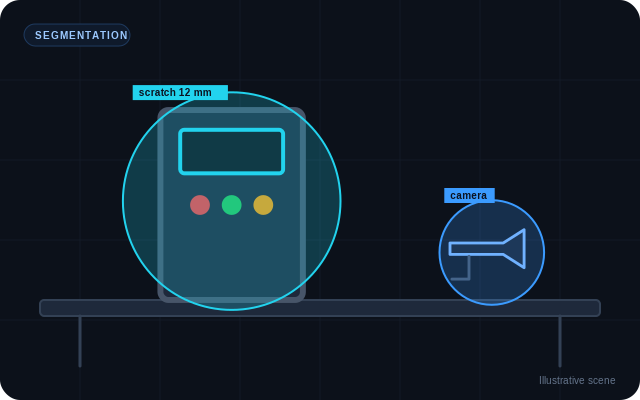
What can be checked
- Scratches and scuffs
- Paint runs and inclusions
- Sink marks and flow lines on molded parts
What the team receives
- Defect locations and classes
- Grade per part
What the solution does
Consistent grading
Applies the same scratch, dent and blemish limits to every part, reducing differences between inspectors and shifts.
Zone awareness
Applies stricter limits on visible surfaces and looser limits on hidden areas, following the part's cosmetic specification.
Process data
Links defects to process steps, tools and batches, so engineers can find the source of recurring cosmetic problems.
The operational problem
Cosmetic defects are judged subjectively and are tiring to inspect, leading to inconsistent quality.
How visual intelligence helps
Controlled lighting reveals scratches, dents and inclusions, and AI models detect and grade them by size and zone. The same acceptance rules are applied to every part, which reduces inspector-to-inspector variation.
Example visual workflow
- Parts are presented under controlled lighting.
- Images are analyzed for cosmetic defects.
- Defects are graded by size and zone.
- Parts are passed or routed to review.
Illustrative workflow — the actual pipeline is designed for each site during the PoC.
Edge deployment considerations
Inspection runs at the line, with images and grades stored per part. Lighting and camera positions are designed together with the model during the PoC.
How the solution is built
AI capabilities
The AI tasks this use case combines.
- Defect Detection
Defect detection locates and classifies specific, known defect types — scratches, cracks, dents, contamination, missing features — in images of products or assets.
- Semantic Segmentation
Semantic segmentation assigns a class to every pixel of an image — road, floor, water, smoke, crop, background — producing a map of regions rather than individual objects.
Visual inputs
Cameras and imaging that typically supply the video.
- Industrial and Machine Vision Cameras
Industrial and machine vision cameras capture sharp, consistent images at fixed positions with controlled lighting and triggering.
Deployment options
General approaches to evaluate, not tested hardware. Specific hardware is selected and validated for each project during the PoC.
- Edge AI Hardware Sizing
Sizing Edge AI hardware means matching compute, memory, power and enclosure to the real workload — the number of streams, resolution, frame rate, models and latency targets — under the site's environmental and installation constraints.
- Edge Deployment Architectures
Edge-first means processing video at or near where it is captured.
- Industrial and Ruggedized Edge AI Computers
Industrial Edge AI computers and ruggedized systems house AI-capable processors in enclosures built for factories, vehicles and outdoor sites — wide temperature ranges, vibration, dust and industrial power.
Practical factors to plan for
Real-world results depend as much on the environment and camera setup as on the model.
Site and setup
- Lighting design. Structured or angled light reveals surface defects.
- Acceptance limits. Defect size and zone limits must be agreed.
Human review
Quality staff review rejects and borderline grades.
Limitations & scope
- Very glossy or dark surfaces are difficult.
- Subjective cosmetic standards must be translated into clear rules.
Proof of Concept
Have a visual AI challenge? Let's prove it.
Share a video of what happens in your environment and describe the outcome you need. We review every request for technical feasibility, then agree the scope of a focused Proof of Concept (PoC) with you.
Example request: “We want to detect scratches on the visible face of injection-molded appliance panels.”
Every request is reviewed for technical feasibility. PoC scope, timing and terms are agreed individually.
Related topics
How this page connects to industries, use cases, AI tasks, input sources and deployment options.