Use CaseVisible weld defects on seams and spots
Weld Seam Inspection
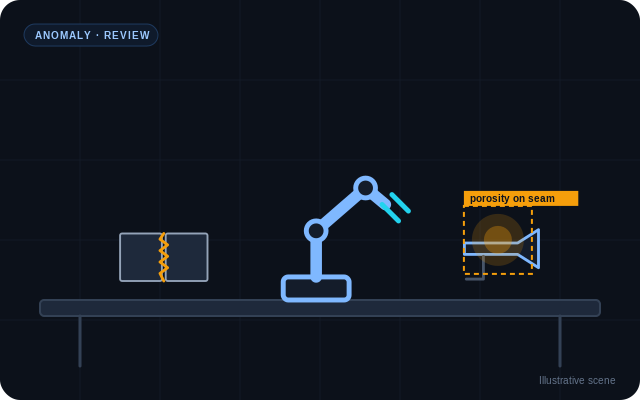
Highlight visible weld defects — porosity, spatter, undercut, missing or misplaced welds — on seams and spot welds in production, supporting weld quality teams.
What can be checked
- Surface porosity and spatter
- Undercut and irregular bead shape
- Missing or misplaced welds
What the team receives
- Pass or review per weld
- Defect images and trends per robot
What the solution does
Every weld checked
Inspects every visible weld seam rather than samples, checking for porosity, spatter, undercut and missing welds.
Robot feedback
Links weld defects to the welding cell, robot and program, so engineers can correct the source of recurring problems.
Fewer escapes
Catches visible weld defects before parts go to painting or assembly, where repairs become more expensive.
The operational problem
Weld defects found late — after painting or at final test — cause expensive rework, and manually inspecting hundreds of welds per unit is tiring and inconsistent.
How visual intelligence helps
Cameras inspect each weld and flag visible defects and missing welds, giving quality teams focused work and process data.
Example visual workflow
- Cameras capture welds after the welding station.
- Images are analyzed for visible defects and positions.
- Flagged welds are routed to inspection.
- Trends are linked to welding robots and parameters.
Illustrative workflow — the actual pipeline is designed for each site during the PoC.
Edge deployment considerations
Analysis runs on an Edge computer at the welding cell, synchronized with the line, so results are available before the part moves on. Images are stored per part serial for traceability.
How the solution is built
AI capabilities
The AI tasks this use case combines.
- Defect Detection
Defect detection locates and classifies specific, known defect types — scratches, cracks, dents, contamination, missing features — in images of products or assets.
- Visual Anomaly Detection
Visual anomaly detection learns what normal looks like and flags images, regions or events that deviate from it.
Visual inputs
Cameras and imaging that typically supply the video.
- Industrial and Machine Vision Cameras
Industrial and machine vision cameras capture sharp, consistent images at fixed positions with controlled lighting and triggering.
- Robotic Vision
Robotic vision places cameras on or around robot arms to guide picking, placement, assembly and inspection.
Deployment options
General approaches to evaluate, not tested hardware. Specific hardware is selected and validated for each project during the PoC.
- Edge AI Hardware Sizing
Sizing Edge AI hardware means matching compute, memory, power and enclosure to the real workload — the number of streams, resolution, frame rate, models and latency targets — under the site's environmental and installation constraints.
- Edge Deployment Architectures
Edge-first means processing video at or near where it is captured.
- Industrial and Ruggedized Edge AI Computers
Industrial Edge AI computers and ruggedized systems house AI-capable processors in enclosures built for factories, vehicles and outdoor sites — wide temperature ranges, vibration, dust and industrial power.
Practical factors to plan for
Real-world results depend as much on the environment and camera setup as on the model.
Site and setup
- Surface reflections. Fresh welds reflect strongly; lighting and filters help.
- Reference geometry. Weld position checks need expected positions per part.
Human review
Weld inspectors review flagged welds and decide on rework. Structural weld acceptance follows applicable standards.
Limitations & scope
- Internal weld defects require ultrasonic or X-ray testing.
- Visual results do not certify weld strength.
Proof of Concept
Have a visual AI challenge? Let's prove it.
Share a video of what happens in your environment and describe the outcome you need. We review every request for technical feasibility, then agree the scope of a focused Proof of Concept (PoC) with you.
Example request: “We want to flag missing spot welds on body-side panels after our welding line.”
Every request is reviewed for technical feasibility. PoC scope, timing and terms are agreed individually.
Related topics
How this page connects to industries, use cases, AI tasks, input sources and deployment options.