Use CaseCamera traps and drone surveys
Wildlife Monitoring
Detect and classify animals in camera trap and drone imagery to support conservation surveys, human-wildlife conflict awareness and biodiversity studies.
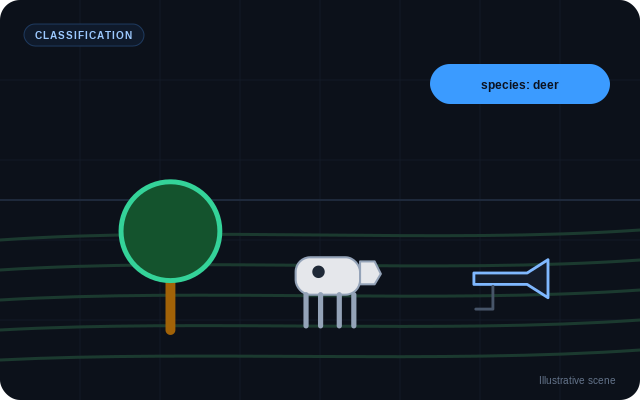
What can be checked
- Animal presence in images
- Species class
- Group size
What the team receives
- Labeled detections
- Survey summaries
What the solution does
Faster review
Filters out empty camera trap images automatically, so researchers spend their time on images that contain animals.
Species classification
Labels species automatically, which speeds up survey analysis.
Field deployment
Can run on low-power devices at camera traps or field stations, which reduces the need to retrieve or transmit all images.
The operational problem
Camera traps produce large volumes of images, mostly empty, that researchers review manually.
How visual intelligence helps
Detection models first remove empty images, then classify animals by species and group size. Uncertain cases are flagged for expert review, which shortens survey analysis considerably.
Example visual workflow
- Camera traps or drones collect images.
- Empty images are filtered.
- Animals are detected and classified.
- Experts review uncertain cases.
Illustrative workflow — the actual pipeline is designed for each site during the PoC.
Edge deployment considerations
Field Edge devices can filter images on site, reducing transmission; analysis can also run after collection.
How the solution is built
AI capabilities
The AI tasks this use case combines.
- Image and Object Classification
Classification assigns a label to a whole image or to an individual object crop — good or defective, running or stopped, product variant A or B.
- Object Detection
Object detection finds and labels the objects in an image or video frame and marks each one with a bounding box.
Visual inputs
Cameras and imaging that typically supply the video.
- Drones & UAVs
Drones capture visual data where fixed cameras cannot reach — long perimeters, large sites, tall structures and remote assets.
- Thermal and Infrared Cameras
Thermal cameras image heat (long-wave infrared), while near-infrared cameras use invisible illumination to see in darkness.
Deployment options
General approaches to evaluate, not tested hardware. Specific hardware is selected and validated for each project during the PoC.
- Edge AI Hardware Sizing
Sizing Edge AI hardware means matching compute, memory, power and enclosure to the real workload — the number of streams, resolution, frame rate, models and latency targets — under the site's environmental and installation constraints.
- Edge Deployment Architectures
Edge-first means processing video at or near where it is captured.
- Hybrid Edge + Cloud Architecture
In a hybrid architecture, time-critical video analysis runs at the edge while selected functions — central dashboards, long-term storage, fleet management or model improvement — run in the Cloud.
- Industrial and Ruggedized Edge AI Computers
Industrial Edge AI computers and ruggedized systems house AI-capable processors in enclosures built for factories, vehicles and outdoor sites — wide temperature ranges, vibration, dust and industrial power.
Practical factors to plan for
Real-world results depend as much on the environment and camera setup as on the model.
Site and setup
- Empty images. Most camera trap images are empty and should be filtered.
- Species variety. Local species need suitable training data.
Human review
Ecologists verify uncertain classifications.
Limitations & scope
- Rare species may be misclassified.
- Night images have lower quality.
Proof of Concept
Have a visual AI challenge? Let's prove it.
Share a video of what happens in your environment and describe the outcome you need. We review every request for technical feasibility, then agree the scope of a focused Proof of Concept (PoC) with you.
Example request: “We want to filter empty camera trap images and classify the remaining animals by species.”
Every request is reviewed for technical feasibility. PoC scope, timing and terms are agreed individually.
Related topics
How this page connects to industries, use cases, AI tasks, input sources and deployment options.