Use CaseErosion, cracks and lightning damage
Wind Turbine Blade Inspection
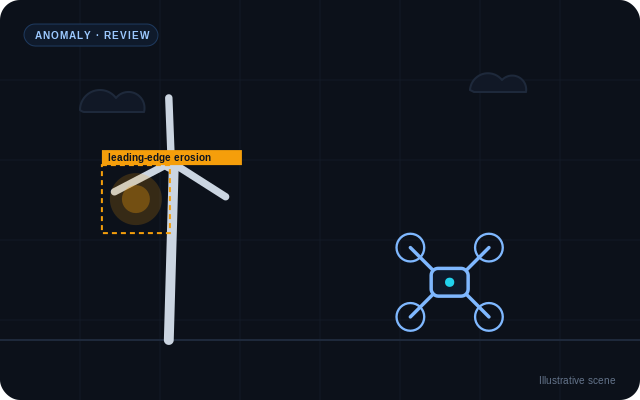
Analyze drone imagery of wind turbine blades to highlight possible leading-edge erosion, cracks, lightning damage and coating issues.
What can be checked
- Leading-edge erosion
- Cracks and delamination indicators
- Lightning strike damage
What the team receives
- Findings per blade and position
- Severity classification
What the solution does
Faster review
Flags likely blade damage in drone inspection images, reducing the time engineers spend screening images manually.
Consistent grading
Applies the same classes across turbines.
Trend tracking
Compares findings with previous inspections of the same blade, so engineers can see how damage develops over time.
The operational problem
Blade inspections produce thousands of images that specialists review manually, delaying repair decisions.
How visual intelligence helps
Models highlight and classify erosion, cracks and lightning damage per blade position. Specialists review a ranked list rather than every image.
Example visual workflow
- A drone captures each blade side.
- Images are analyzed for damage.
- Findings are mapped to blade position.
- Specialists review and classify severity.
Illustrative workflow — the actual pipeline is designed for each site during the PoC.
Edge deployment considerations
Imagery is processed after flights on an Edge computer in the field or in the Cloud for large fleets.
How the solution is built
AI capabilities
The AI tasks this use case combines.
- Defect Detection
Defect detection locates and classifies specific, known defect types — scratches, cracks, dents, contamination, missing features — in images of products or assets.
- Semantic Segmentation
Semantic segmentation assigns a class to every pixel of an image — road, floor, water, smoke, crop, background — producing a map of regions rather than individual objects.
Visual inputs
Cameras and imaging that typically supply the video.
- Drones & UAVs
Drones capture visual data where fixed cameras cannot reach — long perimeters, large sites, tall structures and remote assets.
Deployment options
General approaches to evaluate, not tested hardware. Specific hardware is selected and validated for each project during the PoC.
- Edge AI Hardware Sizing
Sizing Edge AI hardware means matching compute, memory, power and enclosure to the real workload — the number of streams, resolution, frame rate, models and latency targets — under the site's environmental and installation constraints.
- Edge Deployment Architectures
Edge-first means processing video at or near where it is captured.
- Hybrid Edge + Cloud Architecture
In a hybrid architecture, time-critical video analysis runs at the edge while selected functions — central dashboards, long-term storage, fleet management or model improvement — run in the Cloud.
Practical factors to plan for
Real-world results depend as much on the environment and camera setup as on the model.
Site and setup
- Image quality. High-resolution close imagery is needed.
- Severity scale. Classification must follow the owner's scheme.
Human review
Blade specialists review findings and decide on repairs.
Limitations & scope
- Internal damage is not visible.
- Results depend on image quality and weather.
Proof of Concept
Have a visual AI challenge? Let's prove it.
Share a video of what happens in your environment and describe the outcome you need. We review every request for technical feasibility, then agree the scope of a focused Proof of Concept (PoC) with you.
Example request: “We want to classify leading-edge erosion severity in drone images of our onshore turbines.”
Every request is reviewed for technical feasibility. PoC scope, timing and terms are agreed individually.
Related topics
How this page connects to industries, use cases, AI tasks, input sources and deployment options.