Use CaseSeeing objects in the robot's path
AMR Obstacle Perception
Give autonomous mobile robots additional visual perception of obstacles, people and floor hazards, complementing their safety sensors for smoother navigation.
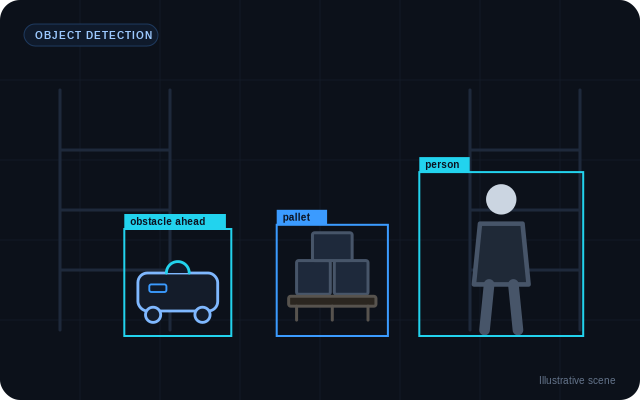
What can be checked
- Obstacles in the path
- People and vehicles nearby
- Floor hazards such as spills or debris
What the team receives
- Perception data to the navigation stack
- Logged obstacle events
What the solution does
Better navigation
Detects pallets, carts and people in the robot's path so the navigation stack can slow down, stop or plan a route around them.
Hazard awareness
Recognizes visible floor hazards such as spills, debris and dropped items that 2D safety scanners may not register.
Fleet insight
Logs where robots are repeatedly blocked so layouts and housekeeping can be improved.
The operational problem
Mobile robots stop or detour when unexpected obstacles appear, and operators lack data on recurring blockages.
How visual intelligence helps
Visual perception helps robots classify obstacles and report them, improving navigation and fleet planning.
Example visual workflow
- Onboard cameras capture the robot’s surroundings.
- Models detect obstacles and people.
- Results are passed to navigation.
- Events are logged for fleet analysis.
Illustrative workflow — the actual pipeline is designed for each site during the PoC.
Edge deployment considerations
Perception runs on onboard embedded modules with strict power and latency budgets. Models are sized to the robot’s compute, and obstacle events are sent to the fleet manager when the robot is connected.
How the solution is built
AI capabilities
The AI tasks this use case combines.
- Object Detection
Object detection finds and labels the objects in an image or video frame and marks each one with a bounding box.
- Semantic Segmentation
Semantic segmentation assigns a class to every pixel of an image — road, floor, water, smoke, crop, background — producing a map of regions rather than individual objects.
Visual inputs
Cameras and imaging that typically supply the video.
- Depth, Stereo and 3D Cameras
Depth cameras measure distance to every point in view, using stereo vision, structured light or time-of-flight.
- Mobile Robots and AMRs
Mobile robots — autonomous mobile robots (AMRs), quadrupeds and inspection robots — carry cameras through facilities and sites on repeatable routes.
Deployment options
General approaches to evaluate, not tested hardware. Specific hardware is selected and validated for each project during the PoC.
- Edge AI Hardware Sizing
Sizing Edge AI hardware means matching compute, memory, power and enclosure to the real workload — the number of streams, resolution, frame rate, models and latency targets — under the site's environmental and installation constraints.
- Edge Deployment Architectures
Edge-first means processing video at or near where it is captured.
- Industrial and Ruggedized Edge AI Computers
Industrial Edge AI computers and ruggedized systems house AI-capable processors in enclosures built for factories, vehicles and outdoor sites — wide temperature ranges, vibration, dust and industrial power.
- NVIDIA Jetson Platforms
NVIDIA Jetson modules combine CPU, GPU and AI acceleration in compact, power-efficient form factors, and are widely used for embedded Edge AI.
- Standalone Edge AI Devices
Standalone Edge AI devices are compact, self-contained units — AI boxes or smart cameras — that process video locally at a single location.
Practical factors to plan for
Real-world results depend as much on the environment and camera setup as on the model.
Site and setup
- Compute budget. Onboard compute and power are limited.
- Integration. Perception must integrate with the robot's navigation software.
Human review
Fleet operators review logged events. Safety functions remain with certified sensors.
Limitations & scope
- Not a replacement for safety-rated sensors.
- Low light reduces perception quality.
Proof of Concept
Have a visual AI challenge? Let's prove it.
Share a video of what happens in your environment and describe the outcome you need. We review every request for technical feasibility, then agree the scope of a focused Proof of Concept (PoC) with you.
Example request: “We want our AMRs to recognize pallets left in aisles and report them to the fleet manager.”
Every request is reviewed for technical feasibility. PoC scope, timing and terms are agreed individually.
Related topics
How this page connects to industries, use cases, AI tasks, input sources and deployment options.