Use CaseDamage, misalignment and spillage
Conveyor Belt Monitoring
Watch conveyor belts for damage, misalignment, spillage and blockages in mining and bulk handling, giving maintenance teams earlier awareness.
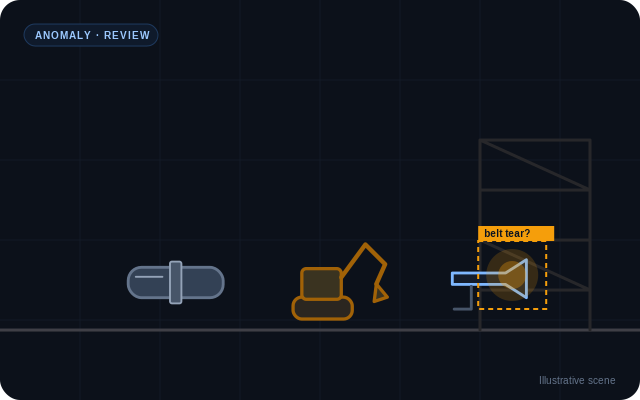
What can be checked
- Belt tears and edge damage
- Belt misalignment
- Spillage and blockages
What the team receives
- Alerts with location
- Trend data per belt
What the solution does
Early detection
Highlights rips, edge damage, splice problems and misalignment early, before they lead to belt failure or an unplanned stop.
Less downtime
Gives maintenance teams the visual evidence to schedule belt repairs into planned shutdowns rather than reacting to breakdowns.
Spillage awareness
Detects spillage and material buildup at transfer points and under belts.
The operational problem
Conveyor belt failures cause costly downtime, and damage such as edge tears or misalignment is often detected late.
How visual intelligence helps
Cameras monitor belt surfaces, edges and transfer points continuously. Damage, misalignment and spillage trigger alerts so maintenance can act before failure.
Example visual workflow
- Cameras view the belt.
- Damage and alignment are analyzed.
- Alerts are generated.
- Maintenance reviews.
Illustrative workflow — the actual pipeline is designed for each site during the PoC.
Edge deployment considerations
Ruggedized Edge devices at the conveyor process video locally in dusty, vibrating environments.
How the solution is built
AI capabilities
The AI tasks this use case combines.
- Defect Detection
Defect detection locates and classifies specific, known defect types — scratches, cracks, dents, contamination, missing features — in images of products or assets.
- Visual Anomaly Detection
Visual anomaly detection learns what normal looks like and flags images, regions or events that deviate from it.
Visual inputs
Cameras and imaging that typically supply the video.
- High-Speed Cameras
High-speed cameras capture hundreds or thousands of frames per second, revealing events too fast for standard cameras — on fast packaging lines, in machinery or in process analysis.
- IP and Network Cameras
IP cameras stream digital video over standard networks and are the most common source for Edge AI video analytics.
Deployment options
General approaches to evaluate, not tested hardware. Specific hardware is selected and validated for each project during the PoC.
- Camera and VMS Integration
Most projects start with cameras that are already installed.
- Edge AI Hardware Sizing
Sizing Edge AI hardware means matching compute, memory, power and enclosure to the real workload — the number of streams, resolution, frame rate, models and latency targets — under the site's environmental and installation constraints.
- Edge Deployment Architectures
Edge-first means processing video at or near where it is captured.
- Industrial and Ruggedized Edge AI Computers
Industrial Edge AI computers and ruggedized systems house AI-capable processors in enclosures built for factories, vehicles and outdoor sites — wide temperature ranges, vibration, dust and industrial power.
Practical factors to plan for
Real-world results depend as much on the environment and camera setup as on the model.
Site and setup
- Dust. Cameras need protection and cleaning.
- Speed. Fast belts need high frame rates.
Human review
Maintenance teams verify alerts and plan repairs.
Limitations & scope
- Damage on the underside may not be visible.
- Dust reduces performance.
Proof of Concept
Have a visual AI challenge? Let's prove it.
Share a video of what happens in your environment and describe the outcome you need. We review every request for technical feasibility, then agree the scope of a focused Proof of Concept (PoC) with you.
Example request: “We want alerts for belt edge damage on our overland conveyor.”
Every request is reviewed for technical feasibility. PoC scope, timing and terms are agreed individually.
Related topics
How this page connects to industries, use cases, AI tasks, input sources and deployment options.