IndustryTerminals, quays and vessels
Edge AI Video Intelligence for Ports and Maritime
Ports handle containers, bulk cargo, vehicles and vessels across large outdoor areas exposed to weather. Edge AI video intelligence can support container and vehicle identification, quay and yard safety, berth activity and perimeter awareness — processed at the terminal.
Common challenges
- Container, chassis and truck identifiers must be captured at gates and quays.
- People, straddle carriers and trucks work in close proximity in yards and on quays.
- Terminals are large, outdoor and exposed to rain, fog, glare and darkness.
- Perimeters along water and land must be monitored continuously.
Typical visual sources
- Fixed and PTZ cameras at gates, quays and yards
- Cameras on cranes and terminal vehicles
- Thermal cameras for perimeter and night conditions
Potential applications
Container and truck identification
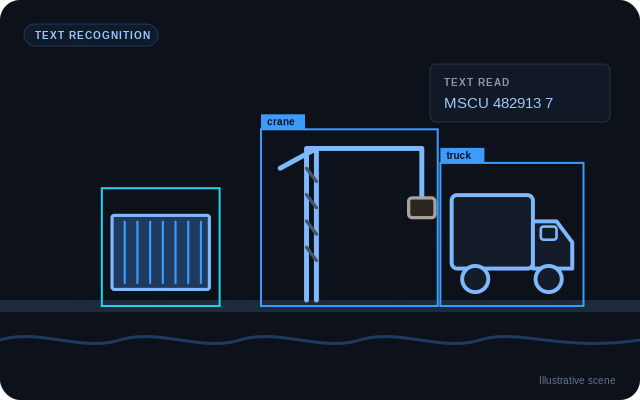
Read container codes and truck identifiers with OCR at gates and under cranes, where visible.
Gate and yard flow
Measure truck queues, dwell time and movements through gates and yard blocks.
Quay and yard safety
Detect people in exclusion zones around cranes and container-handling equipment.
Perimeter awareness
Detect people or small craft approaching restricted areas, including at night.
Scale and exposure
Ports are among the largest outdoor operational sites, with continuous activity and harsh conditions. Video intelligence projects succeed when they focus on well-defined handover points — gates, cranes, quay edges — where camera positions can be controlled and results are clearly useful.
Edge processing at the terminal
Terminals generate large volumes of video. Processing at the terminal reduces backhaul and keeps security-sensitive footage under the operator’s control, with events passed to the terminal operating system.
Questions to answer early
- Which handover point creates the most delay or risk?
- Which identifiers must be captured, and in what conditions?
- What maritime-security requirements apply to the data?
Limitations & scope
- Weather, salt spray and night conditions degrade imaging; camera maintenance and housings are part of the design.
- OCR may need manual confirmation for damaged, dirty or partly hidden codes.
- Port facilities are subject to maritime security regulation that shapes data handling and access.
Proof of Concept
Have a visual AI challenge? Let's prove it.
Share a video of what happens in your environment and describe the outcome you need. We review every request for technical feasibility, then agree the scope of a focused Proof of Concept (PoC) with you.
Example request: “We want to read container numbers as trucks pass through our gate lanes, day and night.”
Every request is reviewed for technical feasibility. PoC scope, timing and terms are agreed individually.
Frequently asked questions
Can container codes be read under cranes?
Crane-mounted cameras can capture container codes during handling. Achievable read rates depend on camera position, motion and code condition, and are measured on terminal footage.
Does this work in fog or heavy rain?
Performance degrades in poor visibility. Thermal cameras help for some tasks, such as perimeter awareness, but not for reading codes.
Related topics
How this page connects to industries, use cases, AI tasks, input sources and deployment options.
Use Cases
- Container Damage Inspection
- Container ID Recognition
- Conveyor Belt Monitoring
- Corrosion Detection
- Crane Lift Zone Monitoring
- Heavy Equipment Utilization Tracking
- License Plate Recognition
- Loading and Unloading Monitoring
- Oil Sheen and Spill Detection on Water
- Perimeter Monitoring and Intrusion Detection
- Queue Monitoring
- Stockpile Volume Estimation
- Vehicle Counting and Classification
- Vessel Detection and Tracking
- VIN Reading
- Workplace Safety Monitoring
- Yard and Trailer Tracking