Use CaseRobots unloading mixed pallets
Depalletizing Guidance
Detect individual cartons, bags or crates on pallets and give robots pick positions for depalletizing, including mixed and irregular loads.
What can be checked
- Individual cartons and bags on a pallet
- Top-layer positions and gaps
- Slip sheets and wrap remnants
What the team receives
- Pick positions for the robot
- Layer and count records
What the solution does
Mixed loads
Locates cartons of different sizes on mixed pallets, so the robot can pick them in a safe order without a fixed pallet pattern.
Fewer manual lifts
Automates heavy, repetitive unloading that strains workers.
Counts
Records the number of cartons picked per pallet and layer.
The operational problem
Manual depalletizing is physically demanding, and mixed loads are hard to automate with fixed programs.
How visual intelligence helps
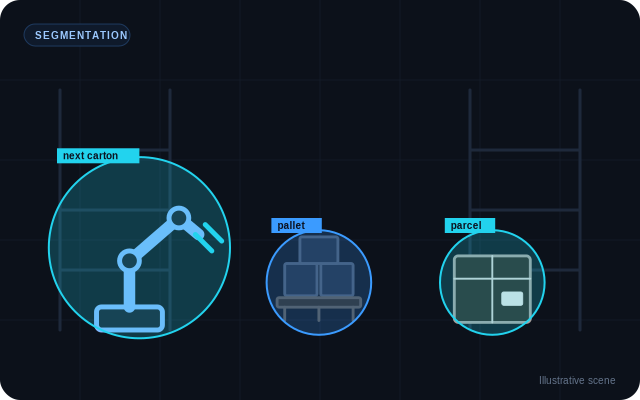
A camera above the pallet combines 2D and depth data to segment individual cartons, bags or crates. The robot receives the next pick position, and the layer is re-imaged after each pick to handle shifting loads.
Example visual workflow
- A camera views the pallet from above.
- Cartons are segmented with depth data.
- Pick positions are sent to the robot.
- Picks and exceptions are logged.
Illustrative workflow — the actual pipeline is designed for each site during the PoC.
Edge deployment considerations
An Edge computer in the cell processes 2D and 3D data with low latency and communicates with the robot controller. Pick logs support commissioning and ongoing tuning.
How the solution is built
AI capabilities
The AI tasks this use case combines.
- Instance Segmentation
Instance segmentation detects each object and outlines its exact pixels — a separate mask per object.
- Object Detection
Object detection finds and labels the objects in an image or video frame and marks each one with a bounding box.
Visual inputs
Cameras and imaging that typically supply the video.
- Depth, Stereo and 3D Cameras
Depth cameras measure distance to every point in view, using stereo vision, structured light or time-of-flight.
- Robotic Vision
Robotic vision places cameras on or around robot arms to guide picking, placement, assembly and inspection.
Deployment options
General approaches to evaluate, not tested hardware. Specific hardware is selected and validated for each project during the PoC.
- Edge AI Hardware Sizing
Sizing Edge AI hardware means matching compute, memory, power and enclosure to the real workload — the number of streams, resolution, frame rate, models and latency targets — under the site's environmental and installation constraints.
- Edge Deployment Architectures
Edge-first means processing video at or near where it is captured.
- Industrial and Ruggedized Edge AI Computers
Industrial Edge AI computers and ruggedized systems house AI-capable processors in enclosures built for factories, vehicles and outdoor sites — wide temperature ranges, vibration, dust and industrial power.
Practical factors to plan for
Real-world results depend as much on the environment and camera setup as on the model.
Site and setup
- Carton appearance. Similar boxes tightly packed need segmentation and depth.
- Wrap remnants. Stretch film must be removed or detected.
Human review
Operators handle exceptions such as damaged cartons.
Limitations & scope
- Damaged or deformed cartons may fail picks.
- Dense film wrap affects perception.
Proof of Concept
Have a visual AI challenge? Let's prove it.
Share a video of what happens in your environment and describe the outcome you need. We review every request for technical feasibility, then agree the scope of a focused Proof of Concept (PoC) with you.
Example request: “We want a robot to depalletize mixed cartons from inbound pallets.”
Every request is reviewed for technical feasibility. PoC scope, timing and terms are agreed individually.
Related topics
How this page connects to industries, use cases, AI tasks, input sources and deployment options.