Use CaseIn-cab awareness for commercial fleets
Driver Fatigue and Distraction Monitoring
Use in-cab cameras to detect signs of driver fatigue and distraction — eyes closing, yawning, phone use, looking away — and give real-time alerts in commercial vehicles, with privacy safeguards.
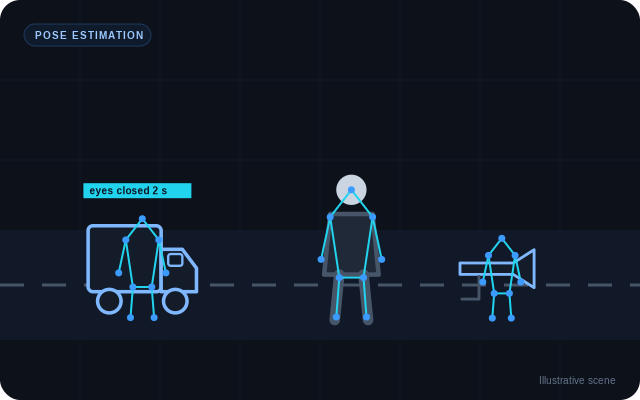
What can be checked
- Prolonged eye closure and yawning
- Phone use and looking away from the road
- Missing seatbelt where visible
What the team receives
- In-cab audio or visual alerts
- Aggregated event statistics for fleet safety
What the solution does
Real-time alerts
Detects signs of eye closure, yawning or phone use in the cab and warns the driver at the moment, not after the trip.
Fleet safety data
Aggregates events by route, shift and time of day, so fleet managers can address scheduling and fatigue risks at the source.
Privacy options
Stores events instead of continuous video.
The operational problem
Fatigue and distraction are major causes of commercial vehicle incidents, and drivers often do not notice their own warning signs.
How visual intelligence helps
An in-cab camera with infrared illumination tracks face and eye keypoints and recognizes behaviors such as eye closure and phone use, alerting drivers in real time.
Example visual workflow
- An in-cab camera observes the driver.
- Face and eye keypoints are analyzed continuously.
- Fatigue or distraction indicators trigger in-cab alerts.
- Aggregated events are reviewed by fleet safety teams.
Illustrative workflow — the actual pipeline is designed for each site during the PoC.
Edge deployment considerations
Analysis runs on an in-vehicle Edge device; only events and short clips, where policy allows, are uploaded when connectivity is available.
How the solution is built
AI capabilities
The AI tasks this use case combines.
- Action and Activity Recognition
Action recognition identifies short actions — picking, lifting, opening a door — while activity recognition describes longer sequences such as a loading operation or a procedure.
- Pose Estimation
Pose estimation locates keypoints — such as shoulders, elbows, knees or the corners of an object — and connects them into a skeleton or structure.
Visual inputs
Cameras and imaging that typically supply the video.
- Thermal and Infrared Cameras
Thermal cameras image heat (long-wave infrared), while near-infrared cameras use invisible illumination to see in darkness.
- Vehicle-Mounted Cameras
Cameras on trucks, rail vehicles, forklifts, buses and service vehicles capture visual data while moving — for road and rail inspection, operational safety and fleet operations.
Deployment options
General approaches to evaluate, not tested hardware. Specific hardware is selected and validated for each project during the PoC.
- Edge AI Hardware Sizing
Sizing Edge AI hardware means matching compute, memory, power and enclosure to the real workload — the number of streams, resolution, frame rate, models and latency targets — under the site's environmental and installation constraints.
- Edge Deployment Architectures
Edge-first means processing video at or near where it is captured.
- Industrial and Ruggedized Edge AI Computers
Industrial Edge AI computers and ruggedized systems house AI-capable processors in enclosures built for factories, vehicles and outdoor sites — wide temperature ranges, vibration, dust and industrial power.
- Standalone Edge AI Devices
Standalone Edge AI devices are compact, self-contained units — AI boxes or smart cameras — that process video locally at a single location.
Practical factors to plan for
Real-world results depend as much on the environment and camera setup as on the model.
Site and setup
- Infrared imaging. Near-infrared illumination keeps detection working at night and through sunglasses in many cases.
- Driver acceptance. Policies on what is recorded and who sees it must be agreed with drivers.
Human review
Drivers receive alerts; fleet safety managers review aggregated events according to agreed policies. Regulatory requirements for driver monitoring systems are checked per market.
Limitations & scope
- Indicators do not measure fatigue directly and can miss or misread some situations.
- Use requires driver consultation and compliance with labor and privacy law.
Proof of Concept
Have a visual AI challenge? Let's prove it.
Share a video of what happens in your environment and describe the outcome you need. We review every request for technical feasibility, then agree the scope of a focused Proof of Concept (PoC) with you.
Example request: “We want in-cab alerts for prolonged eye closure on our long-haul trucks without uploading continuous video.”
Every request is reviewed for technical feasibility. PoC scope, timing and terms are agreed individually.
Related topics
How this page connects to industries, use cases, AI tasks, input sources and deployment options.