Use CaseFruit on trees and vines
Fruit Counting and Yield Estimation
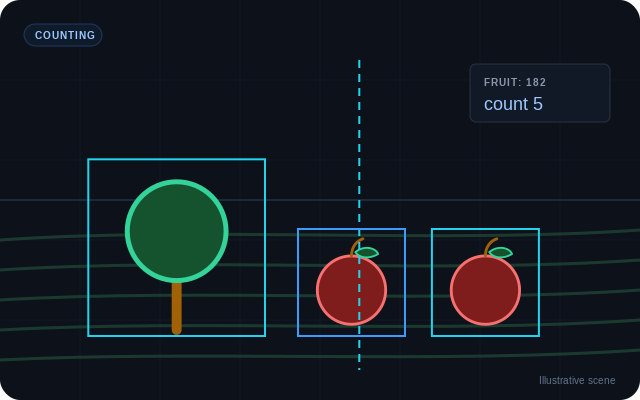
Count visible fruit on trees and vines from vehicle, drone or handheld imagery to support yield estimates and harvest planning.
What can be checked
- Visible fruit
- Fruit size estimates
- Ripeness indicators
What the team receives
- Counts per tree or row
- Yield estimates
What the solution does
Better planning
Gives growers fruit counts per row and block that support planning of harvest labor, bins, storage and transport.
Block comparison
Shows yield variation between blocks and rows.
Repeatable
Supports repeated counts during the season to update yield estimates.
The operational problem
Yield estimation relies on manual samples that may not represent the whole orchard.
How visual intelligence helps
Imagery from vehicles, drones or phones is analyzed to count visible fruit per tree or row. Counts are calibrated with samples to estimate yield per block.
Example visual workflow
- Imagery is captured along rows.
- Fruit is detected and counted.
- Counts are aggregated per block.
- Estimates support planning.
Illustrative workflow — the actual pipeline is designed for each site during the PoC.
Edge deployment considerations
Processing runs on a computer on the vehicle during the pass or after upload, depending on whether results are needed in the field.
How the solution is built
AI capabilities
The AI tasks this use case combines.
- Counting and Measurement
Counting and measurement convert detections, tracks and masks into quantities — how many objects, how long they stayed, how big they are, how full an area is.
- Object Detection
Object detection finds and labels the objects in an image or video frame and marks each one with a bounding box.
Visual inputs
Cameras and imaging that typically supply the video.
- Drones & UAVs
Drones capture visual data where fixed cameras cannot reach — long perimeters, large sites, tall structures and remote assets.
- Mobile Device Cameras
Smartphones and tablets put capable cameras and processors in the hands of field teams.
- Vehicle-Mounted Cameras
Cameras on trucks, rail vehicles, forklifts, buses and service vehicles capture visual data while moving — for road and rail inspection, operational safety and fleet operations.
Deployment options
General approaches to evaluate, not tested hardware. Specific hardware is selected and validated for each project during the PoC.
- Edge AI Hardware Sizing
Sizing Edge AI hardware means matching compute, memory, power and enclosure to the real workload — the number of streams, resolution, frame rate, models and latency targets — under the site's environmental and installation constraints.
- Edge Deployment Architectures
Edge-first means processing video at or near where it is captured.
- Hybrid Edge + Cloud Architecture
In a hybrid architecture, time-critical video analysis runs at the edge while selected functions — central dashboards, long-term storage, fleet management or model improvement — run in the Cloud.
- Standalone Edge AI Devices
Standalone Edge AI devices are compact, self-contained units — AI boxes or smart cameras — that process video locally at a single location.
Practical factors to plan for
Real-world results depend as much on the environment and camera setup as on the model.
Site and setup
- Occlusion. Leaves hide fruit; correction factors are needed.
- Lighting. Sun angle affects visibility.
Human review
Growers use estimates for planning alongside samples.
Limitations & scope
- Hidden fruit is not counted.
- Estimates require calibration with samples.
Proof of Concept
Have a visual AI challenge? Let's prove it.
Share a video of what happens in your environment and describe the outcome you need. We review every request for technical feasibility, then agree the scope of a focused Proof of Concept (PoC) with you.
Example request: “We want apple counts per row from a camera on our orchard tractor.”
Every request is reviewed for technical feasibility. PoC scope, timing and terms are agreed individually.
Related topics
How this page connects to industries, use cases, AI tasks, input sources and deployment options.