Use CaseVehicle access and yard flow
License Plate Recognition
Read vehicle license plates at gates, yards and service lanes to support access workflows and logistics flow, where a legal basis exists and privacy rules are met.
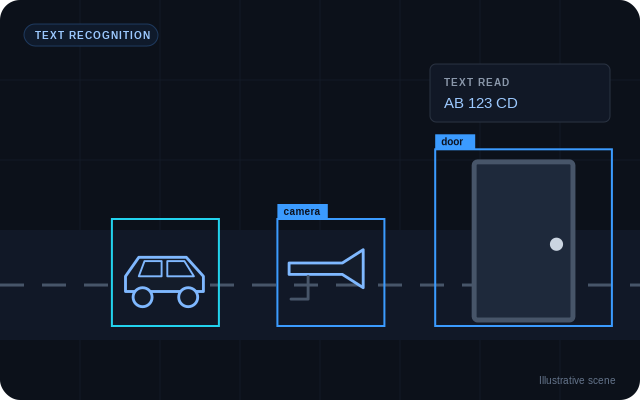
What can be checked
- License plates on approaching vehicles
- Vehicle arrival and departure
- Vehicle type
What the team receives
- Plate text with confidence and timestamp
- Match against permitted lists
What the solution does
Faster access
Reads plates at gates and barriers and checks them against an allow list, reducing manual checks for registered vehicles.
Yard records
Logs arrival and departure times per vehicle, giving yard and site teams an accurate record of visits and dwell times.
Local processing
Keeps plate reads on site, limiting exposure of personal data.
The operational problem
Manual gate check-in creates queues, typing errors and incomplete records of which vehicles entered and left. At busy sites this delays loading slots and makes yard records unreliable.
How visual intelligence helps
Cameras read plates and match them against expected arrivals, so permitted vehicles can be processed faster.
Example visual workflow
- A camera captures the vehicle at the gate.
- The plate is located and read.
- The result is matched against the access list.
- The gate system or staff act on the result.
Illustrative workflow — the actual pipeline is designed for each site during the PoC.
Edge deployment considerations
Plate recognition runs on an Edge device at the gate, so personal data does not need to leave the site.
How the solution is built
AI capabilities
The AI tasks this use case combines.
- Object Detection
Object detection finds and labels the objects in an image or video frame and marks each one with a bounding box.
- OCR and Text Recognition
Optical character recognition (OCR) reads text visible in images — labels, codes, container numbers, displays and gauges.
Visual inputs
Cameras and imaging that typically supply the video.
- IP and Network Cameras
IP cameras stream digital video over standard networks and are the most common source for Edge AI video analytics.
Deployment options
General approaches to evaluate, not tested hardware. Specific hardware is selected and validated for each project during the PoC.
- Camera and VMS Integration
Most projects start with cameras that are already installed.
- Edge AI Hardware Sizing
Sizing Edge AI hardware means matching compute, memory, power and enclosure to the real workload — the number of streams, resolution, frame rate, models and latency targets — under the site's environmental and installation constraints.
- Edge Deployment Architectures
Edge-first means processing video at or near where it is captured.
Practical factors to plan for
Real-world results depend as much on the environment and camera setup as on the model.
Site and setup
- Camera setup. Angle and shutter speed must suit vehicle speed and plate size.
- Legal basis. Plate data is personal data in many jurisdictions.
Human review
Low-confidence reads and unmatched plates are handled by gate staff. Retention follows the privacy policy.
Limitations & scope
- Dirty, damaged or non-standard plates reduce read rates.
- Use requires a legal basis and clear signage.
Proof of Concept
Have a visual AI challenge? Let's prove it.
Share a video of what happens in your environment and describe the outcome you need. We review every request for technical feasibility, then agree the scope of a focused Proof of Concept (PoC) with you.
Example request: “We want to read plates of trucks arriving at our distribution center gate to speed up check-in.”
Every request is reviewed for technical feasibility. PoC scope, timing and terms are agreed individually.
Frequently asked questions
Is LPR allowed?
It depends on jurisdiction, purpose and safeguards. A legal review is required before deployment.
Related topics
How this page connects to industries, use cases, AI tasks, input sources and deployment options.