Use CaseAnimals through gates and in pens
Livestock Counting
Count cattle, sheep, pigs or poultry passing through gates, races or present in pens to support inventory, loading and movement records.
What can be checked
- Animals passing a defined line
- Animals present in a pen
- Direction of movement
What the team receives
- Counts per movement event
- Inventory records per pen
What the solution does
Faster counts
Replaces manual tallying during animal movements.
Movement records
Logs counts per movement event for farm records.
Remote sites
Runs on compact devices suited to remote farm sites.
The operational problem
Manual counts during animal movements are tiring and error-prone, especially with large groups.
How visual intelligence helps
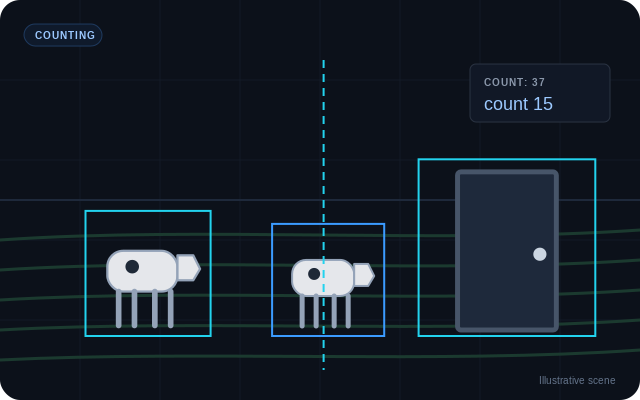
An overhead camera tracks animals through a gate, race or loading ramp and counts each crossing by direction. Counts are recorded per movement event so they can be compared with expected numbers.
Example visual workflow
- An overhead camera views a gate or race.
- Animals are detected and tracked.
- Line crossings are counted by direction.
- Counts are recorded per event.
Illustrative workflow — the actual pipeline is designed for each site during the PoC.
Edge deployment considerations
A low-power Edge device at the gate counts locally and syncs results when connectivity is available.
How the solution is built
AI capabilities
The AI tasks this use case combines.
- Counting and Measurement
Counting and measurement convert detections, tracks and masks into quantities — how many objects, how long they stayed, how big they are, how full an area is.
- Object Tracking and Multi-Object Tracking
Object tracking links detections of the same object across consecutive video frames and assigns each one a persistent ID.
Visual inputs
Cameras and imaging that typically supply the video.
- Drones & UAVs
Drones capture visual data where fixed cameras cannot reach — long perimeters, large sites, tall structures and remote assets.
- IP and Network Cameras
IP cameras stream digital video over standard networks and are the most common source for Edge AI video analytics.
Deployment options
General approaches to evaluate, not tested hardware. Specific hardware is selected and validated for each project during the PoC.
- Camera and VMS Integration
Most projects start with cameras that are already installed.
- Edge AI Hardware Sizing
Sizing Edge AI hardware means matching compute, memory, power and enclosure to the real workload — the number of streams, resolution, frame rate, models and latency targets — under the site's environmental and installation constraints.
- Edge Deployment Architectures
Edge-first means processing video at or near where it is captured.
- Hybrid Edge + Cloud Architecture
In a hybrid architecture, time-critical video analysis runs at the edge while selected functions — central dashboards, long-term storage, fleet management or model improvement — run in the Cloud.
Practical factors to plan for
Real-world results depend as much on the environment and camera setup as on the model.
Site and setup
- Overlap. Animals moving close together are harder to separate.
- Camera height. Overhead views improve accuracy.
Human review
Farm staff confirm counts for official records where required.
Limitations & scope
- Dense groups reduce accuracy.
- Dust and low light affect visibility.
Proof of Concept
Have a visual AI challenge? Let's prove it.
Share a video of what happens in your environment and describe the outcome you need. We review every request for technical feasibility, then agree the scope of a focused Proof of Concept (PoC) with you.
Example request: “We want to count sheep through the race into the yard from an overhead camera.”
Every request is reviewed for technical feasibility. PoC scope, timing and terms are agreed individually.
Related topics
How this page connects to industries, use cases, AI tasks, input sources and deployment options.