Use CaseHow full is a space right now?
Occupancy Monitoring
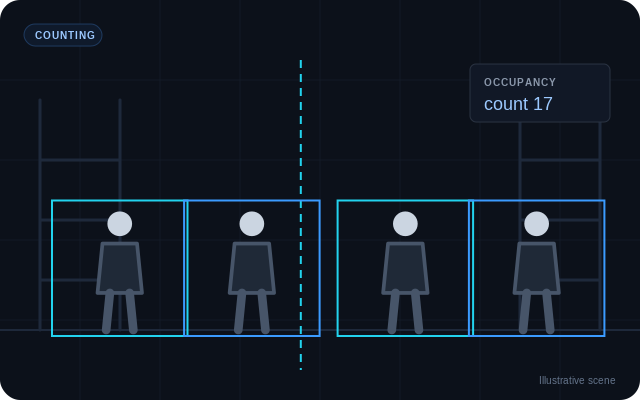
Estimate how many people — or vehicles — are in a defined area at any moment, to manage capacity, staffing, cleaning and space use, using anonymous counts produced at the edge.
What can be checked
- Number of people present in a defined area
- Occupancy by zone within a larger space
- Time periods above or below set thresholds
What the team receives
- Live occupancy per zone
- Threshold alerts for capacity management
- Utilization reports over days and weeks
What the solution does
Real-time utilization
Shows how busy rooms, zones or buildings are now, not only historically.
Supports staffing
Helps align staff, cleaning and services with actual demand.
Privacy-conscious
Uses anonymous counts processed on site without identifying individuals.
The problem
Facilities managers, operators and safety teams need to know how full a space is in real time — not just how many people passed a door. Without that information, staffing, cleaning and capacity management rely on guesswork.
How visual intelligence helps
People are detected and counted either within the area itself or at its entrances. Counts are combined per zone and over time. The output is a live number and historical utilization, without identities.
Deployment considerations
Occupancy suits Edge-only processing with aggregate data sent to dashboards. For multi-building portfolios, Cloud services can combine statistics centrally.
How the solution is built
AI capabilities
The AI tasks this use case combines.
- Counting and Measurement
Counting and measurement convert detections, tracks and masks into quantities — how many objects, how long they stayed, how big they are, how full an area is.
- Object Detection
Object detection finds and labels the objects in an image or video frame and marks each one with a bounding box.
Visual inputs
Cameras and imaging that typically supply the video.
- CCTV and Existing Surveillance Systems
Many sites already run CCTV systems — analog cameras, DVRs, NVRs and video management systems.
- Depth, Stereo and 3D Cameras
Depth cameras measure distance to every point in view, using stereo vision, structured light or time-of-flight.
- IP and Network Cameras
IP cameras stream digital video over standard networks and are the most common source for Edge AI video analytics.
Deployment options
General approaches to evaluate, not tested hardware. Specific hardware is selected and validated for each project during the PoC.
- Camera and VMS Integration
Most projects start with cameras that are already installed.
- Edge AI Hardware Sizing
Sizing Edge AI hardware means matching compute, memory, power and enclosure to the real workload — the number of streams, resolution, frame rate, models and latency targets — under the site's environmental and installation constraints.
- Edge Deployment Architectures
Edge-first means processing video at or near where it is captured.
- Industrial and Ruggedized Edge AI Computers
Industrial Edge AI computers and ruggedized systems house AI-capable processors in enclosures built for factories, vehicles and outdoor sites — wide temperature ranges, vibration, dust and industrial power.
Practical factors to plan for
Real-world results depend as much on the environment and camera setup as on the model.
Site and setup
- Area coverage. Occupancy can be measured by entry and exit counting at doors, or by counting directly within the area; each has different coverage needs.
- Drift correction. Entry and exit counting accumulates small errors over time, so periodic resets or direct counts are used to correct drift.
- Privacy. Occupancy only needs numbers; frames can be discarded immediately after analysis.
Human review
Occupancy figures are estimates. Capacity decisions for safety should combine them with staff judgment and established procedures.
Limitations & scope
- Large open areas with heavy occlusion may need several cameras for reliable counts.
- Counts are approximate; validation against manual counts is part of commissioning.
- Monitoring public or workplace spaces must comply with applicable privacy rules.
Proof of Concept
Have a visual AI challenge? Let's prove it.
Share a video of what happens in your environment and describe the outcome you need. We review every request for technical feasibility, then agree the scope of a focused Proof of Concept (PoC) with you.
Example request: “We want to know how many people are in each of our three waiting areas at any time.”
Every request is reviewed for technical feasibility. PoC scope, timing and terms are agreed individually.
Frequently asked questions
Can occupancy be measured with one camera at the door?
Yes, by counting entries and exits, but the running total drifts over time. Direct counting inside the area, or periodic resets, keeps the figure accurate.
Can this work for parking or vehicles too?
The same principle applies to vehicles; see parking monitoring for vehicle-specific considerations.
Related topics
How this page connects to industries, use cases, AI tasks, input sources and deployment options.
Industries
- Edge AI Video Intelligence for Airports
- Edge AI Video Intelligence for Banking and Finance
- Edge AI Video Intelligence for Education Campuses
- Edge AI Video Intelligence for Facilities and Real Estate
- Edge AI Video Intelligence for Healthcare Facilities
- Edge AI Video Intelligence for Hospitality and Food Service
- Edge AI Video Intelligence for Infrastructure
- Edge AI Video Intelligence for Retail
- Edge AI Video Intelligence for Smart Cities