IndustryRoads, rail, bridges and public assets
Edge AI Video Intelligence for Infrastructure
Transport and public infrastructure — roads, rail, bridges, tunnels and public buildings — must be inspected, kept safe and operated efficiently over long lifetimes. Edge AI video intelligence can support inspection, traffic and incident awareness and asset security.
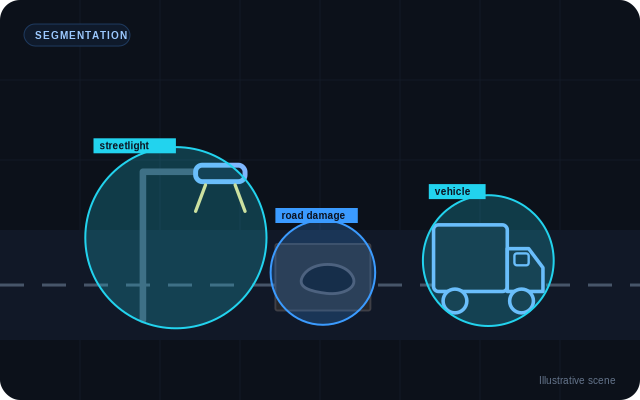
Common challenges
- Large asset networks are inspected periodically and manually, often from vehicles or at height.
- Incidents such as stopped vehicles, debris or obstructions need fast detection.
- Tunnels, depots and substations must be watched continuously for intrusion and tampering.
- Many locations along linear assets have limited power and connectivity.
Typical visual sources
- Fixed and PTZ cameras along roads, tunnels and rail corridors
- Vehicle-mounted cameras on inspection and maintenance vehicles
- Drones for bridges, structures and embankments
Potential applications
Visual asset inspection
Analyze vehicle or drone footage to highlight possible cracks, damage or encroachment for engineers.
Traffic and incident awareness
Detect stopped vehicles, wrong-way movement or obstructions to support operators.
Depot and asset security
Detect intrusion at depots, substations, tunnels and maintenance yards.
Public space operations
Measure anonymous occupancy and flow in stations, terminals and public buildings.
Long-lived, widely distributed assets
Infrastructure owners manage assets that last decades and stretch across regions. Video from fixed cameras, inspection vehicles and drones can increase how often assets are seen. Edge AI helps by highlighting the small fraction of footage that needs an engineer’s attention.
Edge-first along linear assets
Roads and rail lines have many locations with limited backhaul. Processing at the roadside, in the vehicle or on the drone ground station keeps analysis close to the camera and sends findings onward.
Questions to answer early
- Which asset class and defect types are most important?
- Which capture platform is available: fixed, vehicle or aerial?
- How should findings feed the asset management or operations system?
Limitations & scope
- Structural assessment remains the responsibility of qualified engineers; imagery helps prioritize inspection.
- Traffic and incident systems on public roads are often subject to specific standards and procurement rules.
- Public-space video must comply with local regulation and privacy requirements.
Proof of Concept
Have a visual AI challenge? Let's prove it.
Share a video of what happens in your environment and describe the outcome you need. We review every request for technical feasibility, then agree the scope of a focused Proof of Concept (PoC) with you.
Example request: “We want to highlight possible cracks in tunnel lining from footage captured by our inspection vehicle.”
Every request is reviewed for technical feasibility. PoC scope, timing and terms are agreed individually.
Frequently asked questions
Can inspection be done from moving vehicles?
Vehicle-mounted cameras can capture road, rail or tunnel surfaces at speed. Feasibility depends on speed, resolution, lighting and the defect sizes of interest.
Is processing done on the roadside?
It can be. Roadside or vehicle-mounted Edge hardware analyzes video locally and sends events, reducing the need for continuous video backhaul.
Related topics
How this page connects to industries, use cases, AI tasks, input sources and deployment options.
Use Cases
- Aerial Mapping and Feature Extraction
- Bridge and Tunnel Inspection Support
- Construction Progress Monitoring
- Corrosion Detection
- Crack Detection on Concrete and Structures
- Cyclist and Micromobility Counting
- Fastener and Rivet Inspection
- Flood and Water Level Monitoring
- Illegal Parking Detection
- Industrial Visual Inspection
- Occupancy Monitoring
- Pedestrian Crossing Safety Analytics
- Perimeter Monitoring and Intrusion Detection
- Pothole and Road Damage Detection
- Power Line Inspection
- Railway Track Inspection
- Sewer and Pipe Inspection
- Streetlight Outage Detection
- Telecom Tower Inspection
- Traffic Monitoring
- Traffic Sign and Road Asset Inventory
- Vegetation Encroachment Monitoring
- Vehicle Counting and Classification
- Vehicle Speed Estimation for Traffic Studies
- Wrong-Way Driving Detection