Use CaseSpace occupancy and dwell time
Parking Monitoring
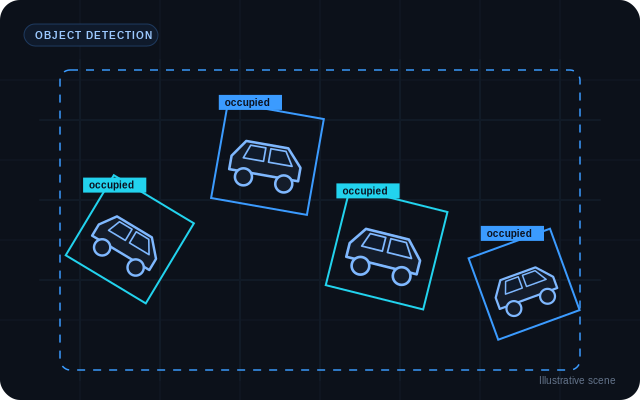
Estimate which parking spaces are free or occupied, how long vehicles stay and where parking rules are broken — in car parks, streets, depots and truck parks — using cameras analyzed at the edge.
What can be checked
- Occupied and free parking spaces or zones
- Vehicle dwell time in spaces
- Vehicles in no-parking, loading or reserved areas
What the team receives
- Live occupancy per space or zone
- Guidance data for signage or apps
- Utilization and dwell-time reports
What the solution does
Live availability
Shows where spaces are free to reduce searching and congestion.
Utilization insight
Reveals how parking is actually used across days and weeks.
Many spaces per camera
Uses camera views covering many bays instead of a sensor per space.
The problem
Drivers waste time searching for spaces, operators lack utilization data, and reserved areas are misused. Per-space sensors are costly to install and maintain.
How visual intelligence helps
Vehicles are detected and mapped to spaces or zones. Occupancy, dwell time and rule violations are derived over time.
Deployment considerations
Edge processing produces occupancy data locally for signs and apps; aggregated data can be shared with central platforms.
How the solution is built
AI capabilities
The AI tasks this use case combines.
- Counting and Measurement
Counting and measurement convert detections, tracks and masks into quantities — how many objects, how long they stayed, how big they are, how full an area is.
- Object Detection
Object detection finds and labels the objects in an image or video frame and marks each one with a bounding box.
Visual inputs
Cameras and imaging that typically supply the video.
- CCTV and Existing Surveillance Systems
Many sites already run CCTV systems — analog cameras, DVRs, NVRs and video management systems.
- IP and Network Cameras
IP cameras stream digital video over standard networks and are the most common source for Edge AI video analytics.
Deployment options
General approaches to evaluate, not tested hardware. Specific hardware is selected and validated for each project during the PoC.
- Camera and VMS Integration
Most projects start with cameras that are already installed.
- Edge AI Hardware Sizing
Sizing Edge AI hardware means matching compute, memory, power and enclosure to the real workload — the number of streams, resolution, frame rate, models and latency targets — under the site's environmental and installation constraints.
- Edge Deployment Architectures
Edge-first means processing video at or near where it is captured.
Practical factors to plan for
Real-world results depend as much on the environment and camera setup as on the model.
Site and setup
- Coverage per camera. One elevated camera can cover many spaces; low angles cause vehicles to hide each other.
- Space definitions. Marked bays are easier to monitor than open lots; zone-based counting suits unmarked areas.
- Outdoor conditions. Shadows, snow covering markings and night lighting affect detection.
Human review
Enforcement actions, if any, require human verification and must follow local regulation. Occupancy data supports guidance and planning.
Limitations & scope
- Occlusion by large vehicles and poor angles reduce per-space accuracy.
- Parking enforcement using cameras has specific legal requirements in most jurisdictions.
- Number-plate reading is a separate capability and is not implied.
Proof of Concept
Have a visual AI challenge? Let's prove it.
Share a video of what happens in your environment and describe the outcome you need. We review every request for technical feasibility, then agree the scope of a focused Proof of Concept (PoC) with you.
Example request: “We want live occupancy of the 60 truck bays in our depot, shown on a screen at the gate.”
Every request is reviewed for technical feasibility. PoC scope, timing and terms are agreed individually.
Frequently asked questions
Do we need a sensor per space?
No. Cameras can monitor many spaces each, if mounted high enough to see the bays clearly.
Can this work for truck parks and depots?
Yes. Zones and vehicle classes are configured for the site, including large vehicles and trailers.
Related topics
How this page connects to industries, use cases, AI tasks, input sources and deployment options.