Use CaseDefects in crawler and robot footage
Sewer and Pipe Inspection
Analyze CCTV crawler and robot footage of sewers and pipes to highlight possible cracks, roots, deposits and joint defects for inspection reports.
What can be checked
- Cracks and fractures
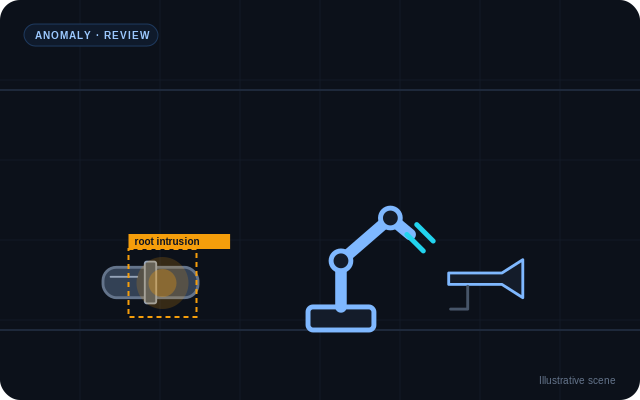
- Root intrusion and deposits
- Displaced or open joints
What the team receives
- Defect list with pipe position
- Draft inspection report
What the solution does
Faster review
Flags likely defects in CCTV survey footage, so inspectors review marked segments rather than watching every minute of video.
Consistent findings
Applies the same detection across surveys.
Position mapping
Links each detected defect to its distance along the pipe, as recorded by the survey crawler, for reporting and repair planning.
The operational problem
Reviewing hours of sewer inspection footage is slow, and results depend on individual inspectors.
How visual intelligence helps
Models analyze crawler footage and highlight possible defects with their distance along the pipe, so inspectors review findings rather than whole videos.
Example visual workflow
- A crawler records the pipe.
- Footage is analyzed for defects.
- Findings are positioned by distance.
- Inspectors review and code.
Illustrative workflow — the actual pipeline is designed for each site during the PoC.
Edge deployment considerations
Footage can be processed in the inspection vehicle or after upload, depending on the workflow.
How the solution is built
AI capabilities
The AI tasks this use case combines.
- Defect Detection
Defect detection locates and classifies specific, known defect types — scratches, cracks, dents, contamination, missing features — in images of products or assets.
- Image and Object Classification
Classification assigns a label to a whole image or to an individual object crop — good or defective, running or stopped, product variant A or B.
Visual inputs
Cameras and imaging that typically supply the video.
- Robotic Vision
Robotic vision places cameras on or around robot arms to guide picking, placement, assembly and inspection.
Deployment options
General approaches to evaluate, not tested hardware. Specific hardware is selected and validated for each project during the PoC.
- Edge AI Hardware Sizing
Sizing Edge AI hardware means matching compute, memory, power and enclosure to the real workload — the number of streams, resolution, frame rate, models and latency targets — under the site's environmental and installation constraints.
- Edge Deployment Architectures
Edge-first means processing video at or near where it is captured.
- Industrial and Ruggedized Edge AI Computers
Industrial Edge AI computers and ruggedized systems house AI-capable processors in enclosures built for factories, vehicles and outdoor sites — wide temperature ranges, vibration, dust and industrial power.
Practical factors to plan for
Real-world results depend as much on the environment and camera setup as on the model.
Site and setup
- Coding standards. Findings should map to the applicable defect coding standard.
- Footage quality. Lighting and camera movement vary between surveys.
Human review
Certified inspectors review and code all findings before reports are issued.
Limitations & scope
- Structural assessment remains with certified inspectors.
- Submerged sections cannot be inspected visually.
Proof of Concept
Have a visual AI challenge? Let's prove it.
Share a video of what happens in your environment and describe the outcome you need. We review every request for technical feasibility, then agree the scope of a focused Proof of Concept (PoC) with you.
Example request: “We want to flag root intrusions and cracks in our sewer crawler footage to speed up coding.”
Every request is reviewed for technical feasibility. PoC scope, timing and terms are agreed individually.
Related topics
How this page connects to industries, use cases, AI tasks, input sources and deployment options.