Use CaseHot spots on motors, bearings and panels
Thermal Equipment Monitoring
Watch motors, bearings, electrical panels and process equipment with thermal cameras to highlight abnormal temperature patterns before they lead to failures.
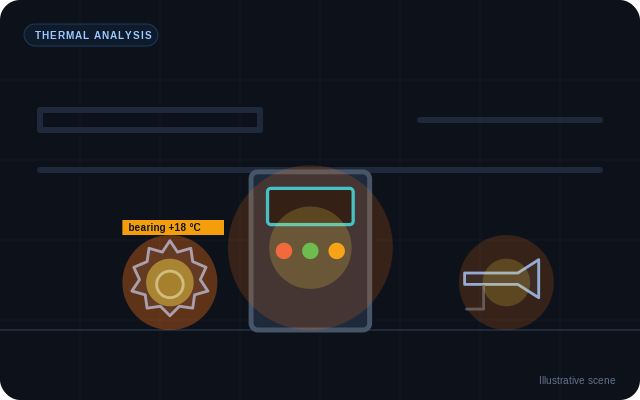
What can be checked
- Temperature rise on motors and bearings
- Hot spots in electrical panels
- Abnormal temperature patterns on process equipment
What the team receives
- Temperature trends per region of interest
- Alerts on abnormal patterns
What the solution does
Continuous coverage
Monitors between periodic thermography rounds.
Early warning
Highlights rising temperatures on motors, bearings, panels and connections, so problems are investigated before they cause failures.
Trend history
Keeps temperature histories for each monitored component, which supports condition-based maintenance planning.
The operational problem
Thermography rounds happen periodically, so overheating that develops between rounds can lead to unplanned failures.
How visual intelligence helps
Fixed thermal cameras track temperature in defined regions over time and compare them with baselines under similar operating conditions. Abnormal patterns are reported to maintenance with images.
Example visual workflow
- Thermal cameras view selected equipment.
- Regions of interest are tracked over time.
- Abnormal patterns are compared with baselines.
- Maintenance receives alerts and trends.
Illustrative workflow — the actual pipeline is designed for each site during the PoC.
Edge deployment considerations
Analysis runs on an Edge device near the cameras, and only trends and alerts are sent to maintenance systems.
How the solution is built
AI capabilities
The AI tasks this use case combines.
- Counting and Measurement
Counting and measurement convert detections, tracks and masks into quantities — how many objects, how long they stayed, how big they are, how full an area is.
- Visual Anomaly Detection
Visual anomaly detection learns what normal looks like and flags images, regions or events that deviate from it.
Visual inputs
Cameras and imaging that typically supply the video.
- Thermal and Infrared Cameras
Thermal cameras image heat (long-wave infrared), while near-infrared cameras use invisible illumination to see in darkness.
Deployment options
General approaches to evaluate, not tested hardware. Specific hardware is selected and validated for each project during the PoC.
- Edge AI Hardware Sizing
Sizing Edge AI hardware means matching compute, memory, power and enclosure to the real workload — the number of streams, resolution, frame rate, models and latency targets — under the site's environmental and installation constraints.
- Edge Deployment Architectures
Edge-first means processing video at or near where it is captured.
- Industrial and Ruggedized Edge AI Computers
Industrial Edge AI computers and ruggedized systems house AI-capable processors in enclosures built for factories, vehicles and outdoor sites — wide temperature ranges, vibration, dust and industrial power.
Practical factors to plan for
Real-world results depend as much on the environment and camera setup as on the model.
Site and setup
- Emissivity. Different surfaces need emissivity settings for meaningful readings.
- Operating state. Temperatures must be compared under similar load conditions.
Human review
Maintenance engineers assess alerts and confirm with other condition data before intervening.
Limitations & scope
- Readings are indicative and depend on emissivity and viewing angle.
- Enclosed equipment must be visible to the camera.
Proof of Concept
Have a visual AI challenge? Let's prove it.
Share a video of what happens in your environment and describe the outcome you need. We review every request for technical feasibility, then agree the scope of a focused Proof of Concept (PoC) with you.
Example request: “We want temperature trend alerts for the gearbox bearings on our three main conveyors.”
Every request is reviewed for technical feasibility. PoC scope, timing and terms are agreed individually.
Related topics
How this page connects to industries, use cases, AI tasks, input sources and deployment options.