Use CaseWeeds versus crop in rows
Weed Detection for Targeted Treatment
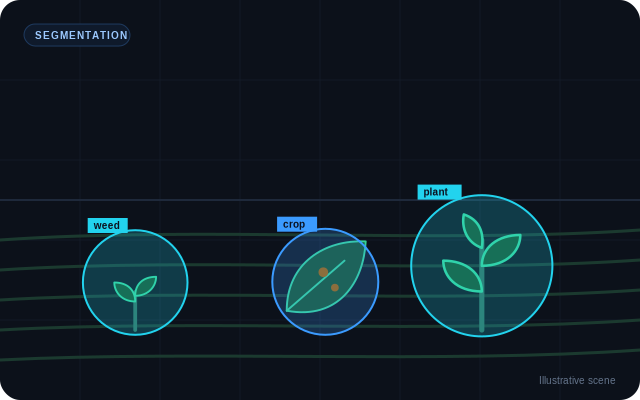
Distinguish weeds from crop plants in camera imagery to support targeted spraying, mechanical weeding and weed pressure mapping.
What can be checked
- Weeds in crop rows
- Weed density
- Crop plants to protect
What the team receives
- Treatment targets
- Weed pressure maps
What the solution does
Reduced chemicals
Treats only where weeds are detected, reducing herbicide use.
Mechanical support
Guides mechanical weeding tools close to crop plants.
Field maps
Records weed pressure maps for future field planning.
The operational problem
Blanket spraying wastes herbicide, and manual weeding is expensive and hard to staff.
How visual intelligence helps
Vision distinguishes weeds from crop plants in real time and passes targets to sprayers or mechanical tools, while also building weed pressure maps.
Example visual workflow
- Cameras on implements capture rows.
- Weeds and crop are segmented.
- Treatment targets are sent to actuators.
- Maps are recorded.
Illustrative workflow — the actual pipeline is designed for each site during the PoC.
Edge deployment considerations
Embedded Edge modules on the implement process images in real time, because spray or hoe decisions must be made within milliseconds.
How the solution is built
AI capabilities
The AI tasks this use case combines.
- Object Detection
Object detection finds and labels the objects in an image or video frame and marks each one with a bounding box.
- Semantic Segmentation
Semantic segmentation assigns a class to every pixel of an image — road, floor, water, smoke, crop, background — producing a map of regions rather than individual objects.
Visual inputs
Cameras and imaging that typically supply the video.
- Drones & UAVs
Drones capture visual data where fixed cameras cannot reach — long perimeters, large sites, tall structures and remote assets.
- Vehicle-Mounted Cameras
Cameras on trucks, rail vehicles, forklifts, buses and service vehicles capture visual data while moving — for road and rail inspection, operational safety and fleet operations.
Deployment options
General approaches to evaluate, not tested hardware. Specific hardware is selected and validated for each project during the PoC.
- Edge AI Hardware Sizing
Sizing Edge AI hardware means matching compute, memory, power and enclosure to the real workload — the number of streams, resolution, frame rate, models and latency targets — under the site's environmental and installation constraints.
- Edge Deployment Architectures
Edge-first means processing video at or near where it is captured.
- Hybrid Edge + Cloud Architecture
In a hybrid architecture, time-critical video analysis runs at the edge while selected functions — central dashboards, long-term storage, fleet management or model improvement — run in the Cloud.
- NVIDIA Jetson Platforms
NVIDIA Jetson modules combine CPU, GPU and AI acceleration in compact, power-efficient form factors, and are widely used for embedded Edge AI.
- Standalone Edge AI Devices
Standalone Edge AI devices are compact, self-contained units — AI boxes or smart cameras — that process video locally at a single location.
Practical factors to plan for
Real-world results depend as much on the environment and camera setup as on the model.
Site and setup
- Latency. On-machine use needs real-time processing.
- Growth stages. Appearance changes over the season.
Human review
Growers set treatment rules and monitor results.
Limitations & scope
- Similar-looking weeds and crops are difficult.
- Integration with machinery is supplier-specific.
Proof of Concept
Have a visual AI challenge? Let's prove it.
Share a video of what happens in your environment and describe the outcome you need. We review every request for technical feasibility, then agree the scope of a focused Proof of Concept (PoC) with you.
Example request: “We want to detect weeds between sugar beet plants from a camera on our hoe.”
Every request is reviewed for technical feasibility. PoC scope, timing and terms are agreed individually.
Related topics
How this page connects to industries, use cases, AI tasks, input sources and deployment options.