Use CaseStructured imagery for inspection programs
Bridge and Tunnel Inspection Support
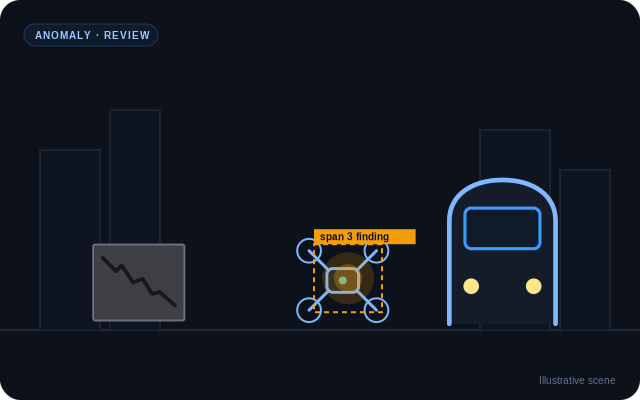
Support bridge and tunnel inspection programs by analyzing drone, robot or vehicle imagery for visible defects and organizing findings per structural element.
What can be checked
- Cracks and spalling
- Corrosion and leaks
- Damaged joints and bearings
What the team receives
- Findings per element
- Inspection report drafts
What the solution does
Structured findings
Organizes findings by structural element.
Reduced access
Lowers the need for lifts and lane closures.
History
Compares findings with previous inspections.
The operational problem
Bridge and tunnel inspections require difficult access and produce unstructured documentation that is hard to compare over time.
How visual intelligence helps
Imagery from drones, robots or vehicles is analyzed for visible defects, and findings are organized per structural element for inspectors.
Example visual workflow
- Imagery is captured.
- Defects are detected.
- Findings are organized per element.
- Inspectors review.
Illustrative workflow — the actual pipeline is designed for each site during the PoC.
Edge deployment considerations
Processing runs after capture on Edge or Cloud infrastructure, and results are exported to inspection management tools.
How the solution is built
AI capabilities
The AI tasks this use case combines.
- Defect Detection
Defect detection locates and classifies specific, known defect types — scratches, cracks, dents, contamination, missing features — in images of products or assets.
- Semantic Segmentation
Semantic segmentation assigns a class to every pixel of an image — road, floor, water, smoke, crop, background — producing a map of regions rather than individual objects.
Visual inputs
Cameras and imaging that typically supply the video.
- Drones & UAVs
Drones capture visual data where fixed cameras cannot reach — long perimeters, large sites, tall structures and remote assets.
- Robotic Vision
Robotic vision places cameras on or around robot arms to guide picking, placement, assembly and inspection.
- Vehicle-Mounted Cameras
Cameras on trucks, rail vehicles, forklifts, buses and service vehicles capture visual data while moving — for road and rail inspection, operational safety and fleet operations.
Deployment options
General approaches to evaluate, not tested hardware. Specific hardware is selected and validated for each project during the PoC.
- Edge AI Hardware Sizing
Sizing Edge AI hardware means matching compute, memory, power and enclosure to the real workload — the number of streams, resolution, frame rate, models and latency targets — under the site's environmental and installation constraints.
- Edge Deployment Architectures
Edge-first means processing video at or near where it is captured.
- Hybrid Edge + Cloud Architecture
In a hybrid architecture, time-critical video analysis runs at the edge while selected functions — central dashboards, long-term storage, fleet management or model improvement — run in the Cloud.
- Industrial and Ruggedized Edge AI Computers
Industrial Edge AI computers and ruggedized systems house AI-capable processors in enclosures built for factories, vehicles and outdoor sites — wide temperature ranges, vibration, dust and industrial power.
- Standalone Edge AI Devices
Standalone Edge AI devices are compact, self-contained units — AI boxes or smart cameras — that process video locally at a single location.
Practical factors to plan for
Real-world results depend as much on the environment and camera setup as on the model.
Site and setup
- Access. Drones and robots reduce access needs.
- Standards. Reports must follow inspection standards.
Human review
Qualified inspectors make all condition ratings and structural assessments; analytics only organize visible findings.
Limitations & scope
- Assessment requires inspectors.
- Hidden defects need other methods.
Proof of Concept
Have a visual AI challenge? Let's prove it.
Share a video of what happens in your environment and describe the outcome you need. We review every request for technical feasibility, then agree the scope of a focused Proof of Concept (PoC) with you.
Example request: “We want findings organized per span from drone images of our viaduct.”
Every request is reviewed for technical feasibility. PoC scope, timing and terms are agreed individually.
Related topics
How this page connects to industries, use cases, AI tasks, input sources and deployment options.