Use CasePeople under suspended loads
Crane Lift Zone Monitoring
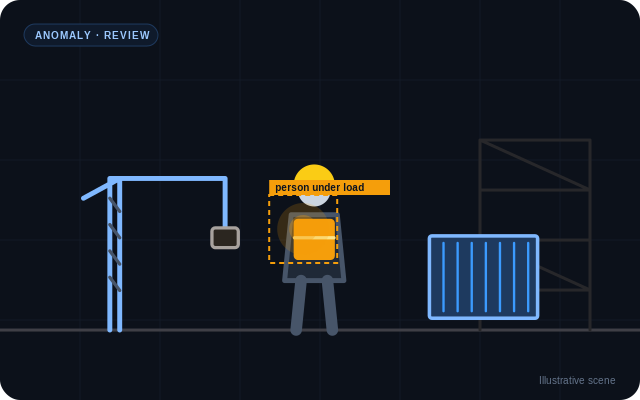
Detect people entering lift zones under or near suspended loads on construction sites, ports and plants, as an extra awareness layer for lifting teams.
What can be checked
- People in lift zones
- Load position
- Zone violations
What the team receives
- Alerts to lift supervisors
- Event logs
What the solution does
Extra awareness
Alerts the crane operator and banksman when a person is detected inside the zone beneath a suspended load, as an extra safeguard.
Dynamic zones
Moves the monitored zone with the suspended load.
Records
Keeps event records that support lift reviews and safety discussions.
The operational problem
People under suspended loads are a major risk, and supervisors cannot see everything.
How visual intelligence helps
Cameras on the crane or around the site detect people inside a lift zone that moves with the load. Supervisors receive alerts and events are logged for lift reviews.
Example visual workflow
- Cameras view the lift area.
- People and loads are detected.
- Violations trigger alerts.
- Events are logged.
Illustrative workflow — the actual pipeline is designed for each site during the PoC.
Edge deployment considerations
Edge devices on the crane or at the site process video in real time, because a lift-zone alert is only useful within seconds.
How the solution is built
AI capabilities
The AI tasks this use case combines.
- Object Detection
Object detection finds and labels the objects in an image or video frame and marks each one with a bounding box.
- Object Tracking and Multi-Object Tracking
Object tracking links detections of the same object across consecutive video frames and assigns each one a persistent ID.
Visual inputs
Cameras and imaging that typically supply the video.
- IP and Network Cameras
IP cameras stream digital video over standard networks and are the most common source for Edge AI video analytics.
- Vehicle-Mounted Cameras
Cameras on trucks, rail vehicles, forklifts, buses and service vehicles capture visual data while moving — for road and rail inspection, operational safety and fleet operations.
Deployment options
General approaches to evaluate, not tested hardware. Specific hardware is selected and validated for each project during the PoC.
- Camera and VMS Integration
Most projects start with cameras that are already installed.
- Edge AI Hardware Sizing
Sizing Edge AI hardware means matching compute, memory, power and enclosure to the real workload — the number of streams, resolution, frame rate, models and latency targets — under the site's environmental and installation constraints.
- Edge Deployment Architectures
Edge-first means processing video at or near where it is captured.
- Standalone Edge AI Devices
Standalone Edge AI devices are compact, self-contained units — AI boxes or smart cameras — that process video locally at a single location.
Practical factors to plan for
Real-world results depend as much on the environment and camera setup as on the model.
Site and setup
- Camera position. Hook or boom cameras give the best view.
- Zones. Lift zones move with the load.
Human review
Lift supervisors act on alerts. Lifting procedures remain mandatory.
Limitations & scope
- Not a certified safety system.
- Occlusion may hide people.
Proof of Concept
Have a visual AI challenge? Let's prove it.
Share a video of what happens in your environment and describe the outcome you need. We review every request for technical feasibility, then agree the scope of a focused Proof of Concept (PoC) with you.
Example request: “We want alerts when people walk under loads lifted by our tower crane.”
Every request is reviewed for technical feasibility. PoC scope, timing and terms are agreed individually.
Related topics
How this page connects to industries, use cases, AI tasks, input sources and deployment options.