Use CaseHigh-bay rack counts from drones
Drone-Based Inventory Scanning
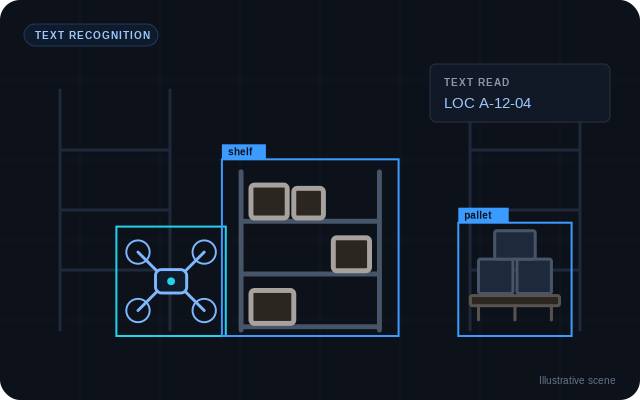
Use indoor drones or mobile robots to capture high-bay racks and read labels or detect pallets, supporting cycle counts without lifts.
What can be checked
- Pallets in rack positions
- Location and pallet labels
- Empty positions
What the team receives
- Inventory snapshots
- Discrepancy lists
What the solution does
Faster counts
Scans high racks without lifts or reach trucks.
Accuracy
Finds discrepancies between racks and records.
Safety
Reduces the need for staff to work at height.
The operational problem
Cycle counts of high-bay racks need lifts or reach trucks, so they are infrequent and discrepancies accumulate.
How visual intelligence helps
An indoor drone or mobile robot captures rack faces; labels are read and pallets detected, and results are compared with warehouse records.
Example visual workflow
- A drone or robot captures racks.
- Labels and pallets are detected.
- Results are compared with the WMS.
- Teams resolve discrepancies.
Illustrative workflow — the actual pipeline is designed for each site during the PoC.
Edge deployment considerations
Images are processed onboard or on a nearby Edge computer after each flight, with discrepancies sent to the warehouse management system.
How the solution is built
AI capabilities
The AI tasks this use case combines.
- Object Detection
Object detection finds and labels the objects in an image or video frame and marks each one with a bounding box.
- OCR and Text Recognition
Optical character recognition (OCR) reads text visible in images — labels, codes, container numbers, displays and gauges.
Visual inputs
Cameras and imaging that typically supply the video.
- Drones & UAVs
Drones capture visual data where fixed cameras cannot reach — long perimeters, large sites, tall structures and remote assets.
- Mobile Robots and AMRs
Mobile robots — autonomous mobile robots (AMRs), quadrupeds and inspection robots — carry cameras through facilities and sites on repeatable routes.
Deployment options
General approaches to evaluate, not tested hardware. Specific hardware is selected and validated for each project during the PoC.
- Edge AI Hardware Sizing
Sizing Edge AI hardware means matching compute, memory, power and enclosure to the real workload — the number of streams, resolution, frame rate, models and latency targets — under the site's environmental and installation constraints.
- Edge Deployment Architectures
Edge-first means processing video at or near where it is captured.
- Hybrid Edge + Cloud Architecture
In a hybrid architecture, time-critical video analysis runs at the edge while selected functions — central dashboards, long-term storage, fleet management or model improvement — run in the Cloud.
- Standalone Edge AI Devices
Standalone Edge AI devices are compact, self-contained units — AI boxes or smart cameras — that process video locally at a single location.
Practical factors to plan for
Real-world results depend as much on the environment and camera setup as on the model.
Site and setup
- Flight safety. Indoor drones need safe operating procedures.
- Label visibility. Labels must face aisles.
Human review
Inventory teams review discrepancy lists and resolve them before updating stock records.
Limitations & scope
- Indoor drone operation needs safety measures.
- Hidden labels cannot be read.
Proof of Concept
Have a visual AI challenge? Let's prove it.
Share a video of what happens in your environment and describe the outcome you need. We review every request for technical feasibility, then agree the scope of a focused Proof of Concept (PoC) with you.
Example request: “We want to compare pallet labels scanned by drone with our WMS for one high-bay aisle.”
Every request is reviewed for technical feasibility. PoC scope, timing and terms are agreed individually.
Related topics
How this page connects to industries, use cases, AI tasks, input sources and deployment options.