Use CaseVisible slicks in harbors and waterways
Oil Sheen and Spill Detection on Water
Highlight visible oil sheens and slicks on water surfaces in harbors, rivers and process ponds as an awareness layer for environmental teams.
What can be checked
- Visible sheens
- Slick extent
- Changes over time
What the team receives
- Alerts with images
- Extent estimates
What the solution does
Early awareness
Highlights visible sheens sooner than periodic inspections.
Extent visibility
Shows the extent of affected water to guide response.
Documentation
Records each event with images for environmental reporting.
The operational problem
Oil spills on water spread quickly and are often noticed late, increasing environmental impact and cleanup costs.
How visual intelligence helps
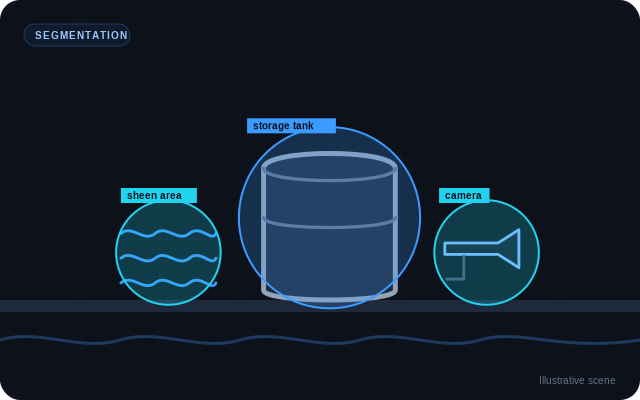
Cameras segment visible sheens on water surfaces and alert environmental teams with images and extent estimates.
Example visual workflow
- Cameras view the water surface.
- Sheens are segmented.
- Alerts are sent.
- Staff verify.
Illustrative workflow — the actual pipeline is designed for each site during the PoC.
Edge deployment considerations
Edge processing at the harbor or pond provides alerts with minimal latency and keeps continuous video on site.
How the solution is built
AI capabilities
The AI tasks this use case combines.
- Semantic Segmentation
Semantic segmentation assigns a class to every pixel of an image — road, floor, water, smoke, crop, background — producing a map of regions rather than individual objects.
- Visual Anomaly Detection
Visual anomaly detection learns what normal looks like and flags images, regions or events that deviate from it.
Visual inputs
Cameras and imaging that typically supply the video.
- Drones & UAVs
Drones capture visual data where fixed cameras cannot reach — long perimeters, large sites, tall structures and remote assets.
- IP and Network Cameras
IP cameras stream digital video over standard networks and are the most common source for Edge AI video analytics.
- Thermal and Infrared Cameras
Thermal cameras image heat (long-wave infrared), while near-infrared cameras use invisible illumination to see in darkness.
Deployment options
General approaches to evaluate, not tested hardware. Specific hardware is selected and validated for each project during the PoC.
- Camera and VMS Integration
Most projects start with cameras that are already installed.
- Edge AI Hardware Sizing
Sizing Edge AI hardware means matching compute, memory, power and enclosure to the real workload — the number of streams, resolution, frame rate, models and latency targets — under the site's environmental and installation constraints.
- Edge Deployment Architectures
Edge-first means processing video at or near where it is captured.
- Hybrid Edge + Cloud Architecture
In a hybrid architecture, time-critical video analysis runs at the edge while selected functions — central dashboards, long-term storage, fleet management or model improvement — run in the Cloud.
- Industrial and Ruggedized Edge AI Computers
Industrial Edge AI computers and ruggedized systems house AI-capable processors in enclosures built for factories, vehicles and outdoor sites — wide temperature ranges, vibration, dust and industrial power.
Practical factors to plan for
Real-world results depend as much on the environment and camera setup as on the model.
Site and setup
- Lighting. Sun angle strongly affects sheen visibility.
- Look-alikes. Algae and wind patterns resemble sheens.
Human review
Environmental staff verify alerts and initiate response.
Limitations & scope
- Thin sheens may be invisible.
- Not a measurement of oil quantity.
Proof of Concept
Have a visual AI challenge? Let's prove it.
Share a video of what happens in your environment and describe the outcome you need. We review every request for technical feasibility, then agree the scope of a focused Proof of Concept (PoC) with you.
Example request: “We want alerts for visible sheens near the outfall of our process water pond.”
Every request is reviewed for technical feasibility. PoC scope, timing and terms are agreed individually.
Related topics
How this page connects to industries, use cases, AI tasks, input sources and deployment options.