Use CaseRight items in every box
Order Packing Verification
Confirm that the expected items, quantities and inserts are placed in a shipment before it is sealed, reducing mispacks and returns.
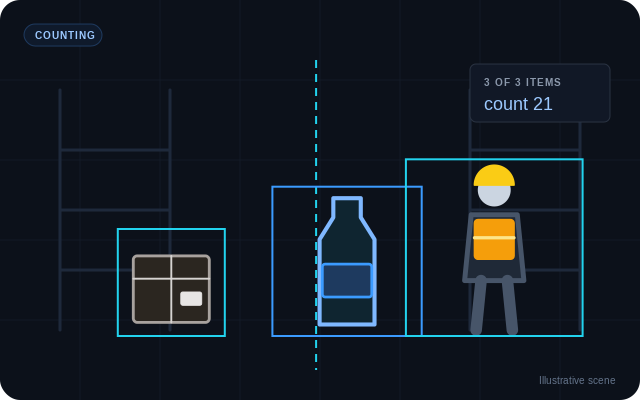
What can be checked
- Items placed in the box
- Item counts per order
- Inserts and documents
What the team receives
- Match or mismatch per order
- Image record of the packed box
What the solution does
Fewer mispacks
Compares items seen in the carton with the order, flagging missing, extra or wrong items before the carton is sealed.
Evidence
Stores an image of each packed order, which helps customer service resolve missing-item claims with evidence.
Low friction
Runs alongside existing barcode scanning at the packing station without adding a separate step for the packer.
The operational problem
Mispacked orders lead to returns, reshipping and dissatisfied customers. Manual checks slow packing.
How visual intelligence helps
An overhead camera observes packing and compares detected items with the order, prompting packers before a box is sealed.
Example visual workflow
- The packer scans the order at the station.
- An overhead camera observes items placed in the box.
- Detected items are compared with the order.
- A mismatch prompts the packer before sealing.
Illustrative workflow — the actual pipeline is designed for each site during the PoC.
Edge deployment considerations
An Edge device per station or zone processes video locally and integrates with the warehouse management system.
How the solution is built
AI capabilities
The AI tasks this use case combines.
- Counting and Measurement
Counting and measurement convert detections, tracks and masks into quantities — how many objects, how long they stayed, how big they are, how full an area is.
- Object Detection
Object detection finds and labels the objects in an image or video frame and marks each one with a bounding box.
Visual inputs
Cameras and imaging that typically supply the video.
- Industrial and Machine Vision Cameras
Industrial and machine vision cameras capture sharp, consistent images at fixed positions with controlled lighting and triggering.
- IP and Network Cameras
IP cameras stream digital video over standard networks and are the most common source for Edge AI video analytics.
Deployment options
General approaches to evaluate, not tested hardware. Specific hardware is selected and validated for each project during the PoC.
- Camera and VMS Integration
Most projects start with cameras that are already installed.
- Edge AI Hardware Sizing
Sizing Edge AI hardware means matching compute, memory, power and enclosure to the real workload — the number of streams, resolution, frame rate, models and latency targets — under the site's environmental and installation constraints.
- Edge Deployment Architectures
Edge-first means processing video at or near where it is captured.
- Industrial and Ruggedized Edge AI Computers
Industrial Edge AI computers and ruggedized systems house AI-capable processors in enclosures built for factories, vehicles and outdoor sites — wide temperature ranges, vibration, dust and industrial power.
Practical factors to plan for
Real-world results depend as much on the environment and camera setup as on the model.
Site and setup
- Item similarity. Visually similar SKUs may require barcode scanning in addition.
- Station layout. An overhead camera must see the box interior.
Human review
Packers resolve mismatches. Image records support customer service investigations.
Limitations & scope
- Items hidden under others may not be visible.
- Very similar products may be confused.
Proof of Concept
Have a visual AI challenge? Let's prove it.
Share a video of what happens in your environment and describe the outcome you need. We review every request for technical feasibility, then agree the scope of a focused Proof of Concept (PoC) with you.
Example request: “We want to confirm the right number of items is in each box at our single-order packing stations.”
Every request is reviewed for technical feasibility. PoC scope, timing and terms are agreed individually.
Related topics
How this page connects to industries, use cases, AI tasks, input sources and deployment options.