Use CasePallets in lanes, docks and stacks
Pallet Counting and Identification
Count pallets in staging lanes, docks and storage areas and read pallet labels where visible, supporting inventory accuracy and dock planning.
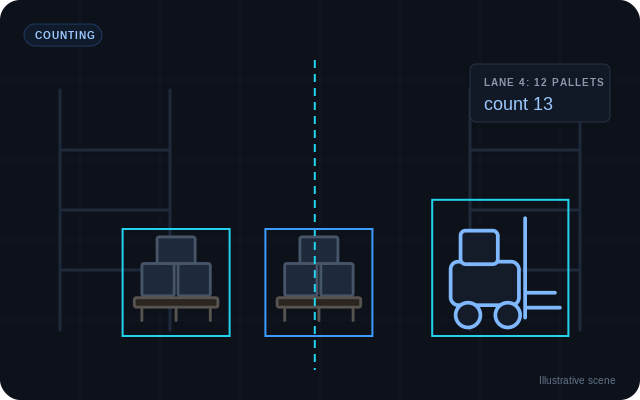
What can be checked
- Pallets in lanes and zones
- Pallet labels
- Empty and occupied positions
What the team receives
- Counts per lane or zone
- Label reads linked to positions
What the solution does
Inventory accuracy
Counts pallets in staging lanes and storage zones and compares them with system records, so mismatches are found sooner.
Dock planning
Shows how full each staging lane is before trucks arrive.
Faster checks
Reduces manual counting rounds in lanes and storage zones.
The operational problem
Staging lanes and storage zones are counted manually, and records often differ from reality.
How visual intelligence helps
Cameras view staging lanes and storage zones, count pallets and read labels where visible. Counts are compared with warehouse records so discrepancies are found early.
Example visual workflow
- Cameras view lanes and zones.
- Pallets are detected and counted.
- Labels are read where visible.
- Counts are compared with the WMS.
Illustrative workflow — the actual pipeline is designed for each site during the PoC.
Edge deployment considerations
Edge servers in the warehouse process video from many cameras and integrate with the warehouse management system.
How the solution is built
AI capabilities
The AI tasks this use case combines.
- Counting and Measurement
Counting and measurement convert detections, tracks and masks into quantities — how many objects, how long they stayed, how big they are, how full an area is.
- Object Detection
Object detection finds and labels the objects in an image or video frame and marks each one with a bounding box.
Visual inputs
Cameras and imaging that typically supply the video.
- Drones & UAVs
Drones capture visual data where fixed cameras cannot reach — long perimeters, large sites, tall structures and remote assets.
- IP and Network Cameras
IP cameras stream digital video over standard networks and are the most common source for Edge AI video analytics.
Deployment options
General approaches to evaluate, not tested hardware. Specific hardware is selected and validated for each project during the PoC.
- Camera and VMS Integration
Most projects start with cameras that are already installed.
- Edge AI Hardware Sizing
Sizing Edge AI hardware means matching compute, memory, power and enclosure to the real workload — the number of streams, resolution, frame rate, models and latency targets — under the site's environmental and installation constraints.
- Edge Deployment Architectures
Edge-first means processing video at or near where it is captured.
- Hybrid Edge + Cloud Architecture
In a hybrid architecture, time-critical video analysis runs at the edge while selected functions — central dashboards, long-term storage, fleet management or model improvement — run in the Cloud.
Practical factors to plan for
Real-world results depend as much on the environment and camera setup as on the model.
Site and setup
- Views. Stacks can hide pallets behind each other.
- Labels. Labels must face the camera to be read.
Human review
Warehouse staff resolve count mismatches.
Limitations & scope
- Hidden pallets are not counted.
- Label reading depends on orientation.
Proof of Concept
Have a visual AI challenge? Let's prove it.
Share a video of what happens in your environment and describe the outcome you need. We review every request for technical feasibility, then agree the scope of a focused Proof of Concept (PoC) with you.
Example request: “We want pallet counts per staging lane at our outbound docks every five minutes.”
Every request is reviewed for technical feasibility. PoC scope, timing and terms are agreed individually.
Related topics
How this page connects to industries, use cases, AI tasks, input sources and deployment options.