Use CaseWorkplace safety
PPE Compliance Monitoring
Use video analytics to check whether required personal protective equipment is worn in defined areas, and route possible violations to the people responsible — with processing at the edge, close to the cameras.
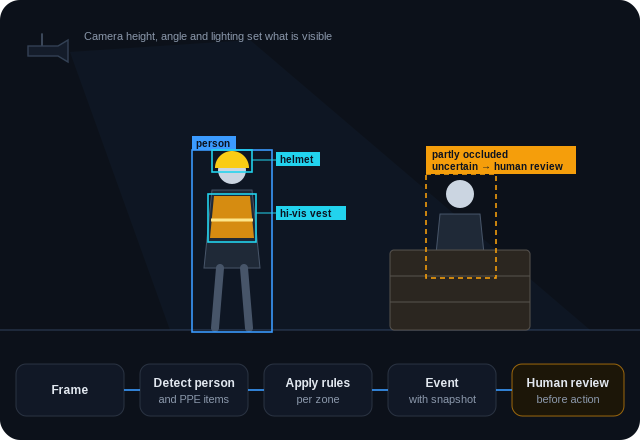
What can be checked
- Hard hats and safety helmets
- High-visibility vests and clothing
- Site-specific PPE such as masks, goggles or gloves — evaluated case by case, as small items are harder to detect
- People present in zones where specific PPE is required
What the team receives
- Events with time, camera, zone and an image for review
- Notifications to supervisors through agreed channels
- Compliance summaries by zone, shift or period
- Uncertain cases flagged separately for human review
What the solution does
Consistent coverage
Applies the same PPE rules across cameras and shifts, complementing spot checks and walk-arounds rather than replacing them.
Zone-specific rules
Defines which equipment is required in which area, so a hard-hat zone and a clean-room zone can follow different rules.
Processing at the edge
Analyzes video on an Edge AI computer on site, so footage does not have to leave the facility and alerts are raised locally.
The operational problem
Safety teams cannot watch every entrance, line and loading area on every shift. Spot checks are valuable but intermittent, and incidents often happen between them. PPE compliance monitoring aims to apply defined rules consistently and bring possible issues to the right person’s attention — not to automate safety decisions.
How it works
- Capture — fixed cameras covering the relevant zones provide the video. Mobile platforms are occasionally used for temporary or large areas.
- Detect — an object detection model locates people and the PPE items of interest in each frame.
- Track — object tracking, a processing mode built on detection, follows each person across frames so one situation produces one event rather than many.
- Apply rules — detections are checked against the PPE required in that camera zone.
- Report and review — possible violations become events with a snapshot. Uncertain cases are flagged for human review.
Where the processing runs
PPE monitoring is usually well suited to Edge-only processing: an Edge AI computer on site analyzes the streams and raises alerts on the local network. A Cloud component can be added for central dashboards across several sites, receiving events and metadata rather than continuous video.
What a proof of concept should answer
A focused proof of concept on representative footage should show which PPE items can be assessed reliably from your camera positions, the expected balance of missed and false alerts, and which camera changes, if any, would improve results.
How the solution is built
AI capabilities
The AI tasks this use case combines.
- Attribute Recognition
Attribute recognition determines properties of an object found by a detector — color, type, state, whether a helmet or vest is worn, whether a door is open.
- Object Detection
Object detection finds and labels the objects in an image or video frame and marks each one with a bounding box.
Deployment options
General approaches to evaluate, not tested hardware. Specific hardware is selected and validated for each project during the PoC.
- Edge AI Hardware Sizing
Sizing Edge AI hardware means matching compute, memory, power and enclosure to the real workload — the number of streams, resolution, frame rate, models and latency targets — under the site's environmental and installation constraints.
- Edge Deployment Architectures
Edge-first means processing video at or near where it is captured.
Practical factors to plan for
Real-world results depend as much on the environment and camera setup as on the model.
Site and setup
- Camera placement and angle. PPE is easiest to assess when people are seen from the front or side at a sufficient size. High, distant or steep views reduce reliability.
- Occlusion. Machinery, materials and other people can hide parts of a person. Partly visible people should produce uncertain results, not violations.
- Lighting and conditions. Glare, backlight, low light, dust and steam all affect detection. Night or outdoor operation may need additional evaluation.
- PPE variation. Helmets, vests and other equipment differ in color, shape and style between sites. Models are evaluated against the equipment actually used.
- Detection thresholds. Thresholds balance missed violations against false alerts. They are agreed with the safety team and reviewed after real-world operation.
- Privacy. PPE monitoring concerns equipment and zones, not identity. Retention, access and signage should follow your policies and local regulation.
Human review
Results support safety supervisors; they do not replace them. Uncertain or low-confidence detections are reviewed by a person before any action, and alerts should not be used as the sole basis for disciplinary decisions.
Limitations & scope
- No system detects PPE perfectly. Small items, distant people and partly hidden people are harder to assess reliably.
- Performance must be measured on footage from your own site; results from other environments should not be assumed.
- PPE monitoring supports your safety management system, training and legal obligations; it does not replace them.
Proof of Concept
Have a visual AI challenge? Let's prove it.
Share a video of what happens in your environment and describe the outcome you need. We review every request for technical feasibility, then agree the scope of a focused Proof of Concept (PoC) with you.
Every request is reviewed for technical feasibility. PoC scope, timing and terms are agreed individually.
Frequently asked questions
Which PPE items can be checked?
Hard hats and high-visibility vests are typical starting points because they are large and distinctive. Other items, such as goggles, masks or gloves, are evaluated on your footage before they are included.
Does PPE monitoring identify individual workers?
No identification is needed for PPE monitoring; it focuses on equipment and zones. Any decision to add identification is separate, and must follow your privacy policy and local regulation.
Can it run without sending video to the Cloud?
Yes. Processing can run entirely on an Edge AI computer on site. Cloud services are optional, for example for multi-site reporting.
How is performance assessed?
During a proof of concept, results are compared with manually reviewed footage from your site. The report states measured performance, observed failure cases and recommended thresholds.
Related topics
How this page connects to industries, use cases, AI tasks, input sources and deployment options.