Use CaseWaiting lines and service points
Queue Monitoring
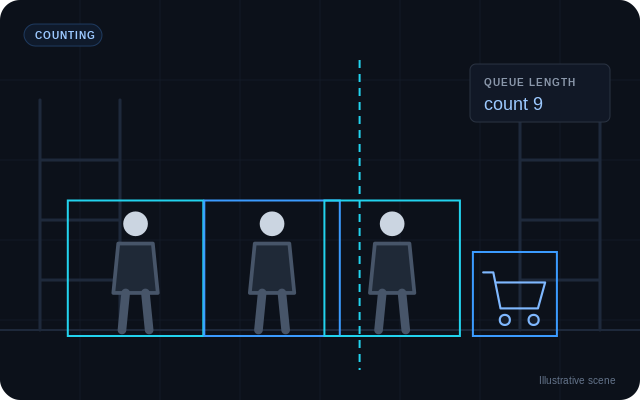
Measure queue length and estimated waiting time at checkouts, counters, gates and service points — for people or vehicles — so staffing and lanes can be adjusted before queues become a problem.
What can be checked
- Number of people or vehicles in a defined queue area
- Queue length trends over time
- Estimated waiting time from movement through the queue
What the team receives
- Live queue length per service point
- Threshold alerts to open lanes or add staff
- Reports of peak times and service levels
What the solution does
Proactive staffing
Signals when queues build so additional counters or lanes can be opened in time.
Service-level data
Provides trend data on queue lengths and peaks for planning.
Anonymous processing
Uses counts and short-term movement processed on site, without identifying individuals.
The problem
Long queues frustrate customers, delay trucks and waste capacity. Staff often notice them too late, and service-level reporting relies on estimates.
How visual intelligence helps
People or vehicles are detected and counted within a queue zone; tracking measures flow through it. The result is live queue length, estimated waiting time and alerts.
Deployment considerations
Queue monitoring suits Edge-only processing with dashboards on the local network, and aggregated data shared centrally for multi-site operators.
How the solution is built
AI capabilities
The AI tasks this use case combines.
- Counting and Measurement
Counting and measurement convert detections, tracks and masks into quantities — how many objects, how long they stayed, how big they are, how full an area is.
- Object Detection
Object detection finds and labels the objects in an image or video frame and marks each one with a bounding box.
- Object Tracking and Multi-Object Tracking
Object tracking links detections of the same object across consecutive video frames and assigns each one a persistent ID.
Visual inputs
Cameras and imaging that typically supply the video.
- CCTV and Existing Surveillance Systems
Many sites already run CCTV systems — analog cameras, DVRs, NVRs and video management systems.
- IP and Network Cameras
IP cameras stream digital video over standard networks and are the most common source for Edge AI video analytics.
Deployment options
General approaches to evaluate, not tested hardware. Specific hardware is selected and validated for each project during the PoC.
- Camera and VMS Integration
Most projects start with cameras that are already installed.
- Edge AI Hardware Sizing
Sizing Edge AI hardware means matching compute, memory, power and enclosure to the real workload — the number of streams, resolution, frame rate, models and latency targets — under the site's environmental and installation constraints.
- Edge Deployment Architectures
Edge-first means processing video at or near where it is captured.
Practical factors to plan for
Real-world results depend as much on the environment and camera setup as on the model.
Site and setup
- Queue shape. Queues that snake, split or overflow beyond the camera view need wider coverage or multiple cameras.
- Wait-time estimation. Waiting time is estimated from tracked movement and service rates; it is an approximation, especially in irregular queues.
- Privacy. Queue monitoring needs counts and movement, not identities; frames can be discarded after analysis.
Human review
Staff decide whether and how to respond to queue alerts; figures are estimates to support those decisions.
Limitations & scope
- Very dense or irregular queues reduce counting and wait-time accuracy.
- Queue monitoring of customers or travelers must follow privacy regulation and signage rules.
- Estimates support decisions; they are not exact measurements.
Proof of Concept
Have a visual AI challenge? Let's prove it.
Share a video of what happens in your environment and describe the outcome you need. We review every request for technical feasibility, then agree the scope of a focused Proof of Concept (PoC) with you.
Example request: “We want an alert when the queue at our truck gate exceeds eight vehicles.”
Every request is reviewed for technical feasibility. PoC scope, timing and terms are agreed individually.
Frequently asked questions
Can it work for vehicles at gates?
Yes. The same approach applies to vehicle queues at gates, weighbridges or drive-through lanes, using vehicle detection instead of people detection.
How is waiting time estimated?
By tracking how quickly people or vehicles move through the queue area, combined with queue length. It is an estimate rather than a measured time per person.
Related topics
How this page connects to industries, use cases, AI tasks, input sources and deployment options.
Industries
- Edge AI Video Intelligence for Airports
- Edge AI Video Intelligence for Banking and Finance
- Edge AI Video Intelligence for Healthcare Facilities
- Edge AI Video Intelligence for Hospitality and Food Service
- Edge AI Video Intelligence for Logistics
- Edge AI Video Intelligence for Ports and Maritime
- Edge AI Video Intelligence for Retail