Use CaseLiquids, leaks and debris on surfaces
Spill Detection
Flag visible spills, leaks, pooling liquid or debris on floors, process areas and outdoor surfaces, so teams can respond sooner — using cameras and Edge AI as an additional awareness layer.
What can be checked
- Pooling liquid on floors, bunds or paved areas
- Visible leaks from equipment, pipes or containers
- Debris or dropped material in walkways or vehicle lanes
What the team receives
- Alerts with location and snapshot
- Event history for housekeeping and maintenance
What the solution does
Earlier awareness
Highlights visible spills between inspections or patrols.
Pinpoints location
Shows where the spill is so the right team can respond.
Runs locally
Analyzes video on site so alerts work without external connectivity.
The problem
Spills create slip hazards, product losses and environmental risks. They are often found late, during routine walks, especially in large areas or outside working hours.
How visual intelligence helps
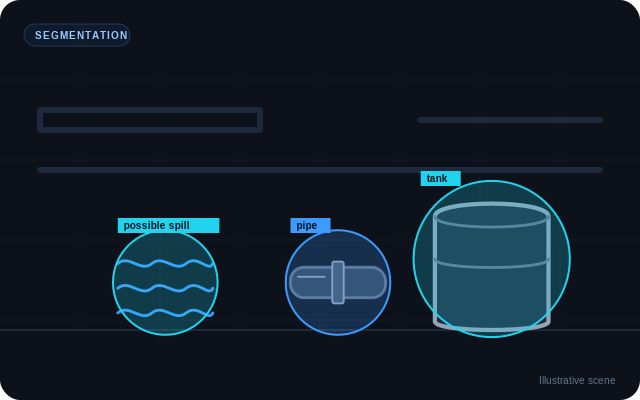
Segmentation models outline regions that look like spills or debris; anomaly detection can flag changes from a normal floor appearance. Alerts include the location and an image for quick checking.
Deployment considerations
Edge processing keeps alerts local. Because spills can be subtle, evaluation on footage from the specific area — with normal and spill conditions — is essential before deployment.
How the solution is built
AI capabilities
The AI tasks this use case combines.
- Instance Segmentation
Instance segmentation detects each object and outlines its exact pixels — a separate mask per object.
- Semantic Segmentation
Semantic segmentation assigns a class to every pixel of an image — road, floor, water, smoke, crop, background — producing a map of regions rather than individual objects.
- Visual Anomaly Detection
Visual anomaly detection learns what normal looks like and flags images, regions or events that deviate from it.
Visual inputs
Cameras and imaging that typically supply the video.
- IP and Network Cameras
IP cameras stream digital video over standard networks and are the most common source for Edge AI video analytics.
- Thermal and Infrared Cameras
Thermal cameras image heat (long-wave infrared), while near-infrared cameras use invisible illumination to see in darkness.
Deployment options
General approaches to evaluate, not tested hardware. Specific hardware is selected and validated for each project during the PoC.
- Camera and VMS Integration
Most projects start with cameras that are already installed.
- Edge AI Hardware Sizing
Sizing Edge AI hardware means matching compute, memory, power and enclosure to the real workload — the number of streams, resolution, frame rate, models and latency targets — under the site's environmental and installation constraints.
- Edge Deployment Architectures
Edge-first means processing video at or near where it is captured.
- Industrial and Ruggedized Edge AI Computers
Industrial Edge AI computers and ruggedized systems house AI-capable processors in enclosures built for factories, vehicles and outdoor sites — wide temperature ranges, vibration, dust and industrial power.
Practical factors to plan for
Real-world results depend as much on the environment and camera setup as on the model.
Site and setup
- Surface and lighting. Transparent liquids on reflective floors are hard to see; lighting and camera angle strongly affect detection.
- Normal variation. Wet cleaning, puddles after rain or normal process fluids must be distinguished from real spills.
- Segmentation approach. Spills have irregular shapes, so segmentation is usually more suitable than bounding-box detection.
Human review
Alerts are checked by staff before response. The system does not identify the substance or its hazard.
Limitations & scope
- Clear liquids, low light and reflective surfaces significantly reduce detection reliability.
- Visual spill detection does not identify substances and does not replace leak detection, gas detection or environmental monitoring systems.
- Each area needs evaluation on real footage, including normal wet conditions.
Proof of Concept
Have a visual AI challenge? Let's prove it.
Share a video of what happens in your environment and describe the outcome you need. We review every request for technical feasibility, then agree the scope of a focused Proof of Concept (PoC) with you.
Example request: “We want to detect oil pooling under machinery in our workshop before someone slips.”
Every request is reviewed for technical feasibility. PoC scope, timing and terms are agreed individually.
Frequently asked questions
Can clear liquids like water be detected?
Sometimes, through reflections and surface changes, but reliability is lower than for colored or opaque liquids. It depends on lighting and floor type.
Is this suitable for hazardous chemicals?
It can add awareness, but hazardous substance detection requires certified sensors and procedures. Video does not identify the substance.
Related topics
How this page connects to industries, use cases, AI tasks, input sources and deployment options.