Use CaseRight product, right place
Product Detection and Verification
Detect, identify and verify products, parts or packages as they move through production, packing or logistics — confirming the right item is in the right place, in the right quantity and orientation.
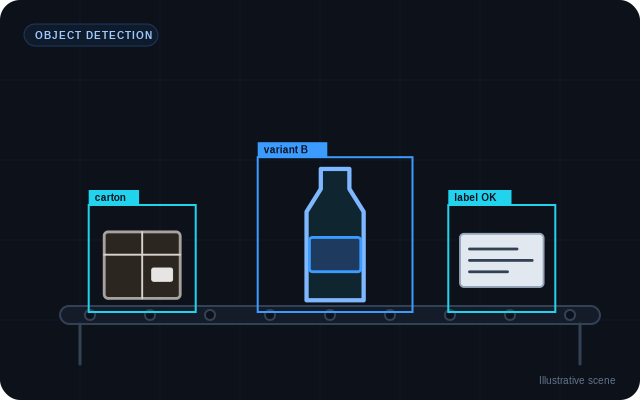
What can be checked
- Presence or absence of a product, part or package at a station
- Product type or variant, where variants differ visibly
- Orientation and position on a conveyor or fixture
- Labels, codes or printed text, where legible
What the team receives
- Verification results per item with image evidence
- Mismatch alerts, such as the wrong variant or a missing item
- Counts and throughput by product type
What the solution does
Prevents mix-ups
Flags wrong variants or missing items before they reach the next process or the customer.
Counts as it verifies
Produces counts by product type as a by-product of verification.
Works with existing stations
Uses cameras positioned at existing stations, conveyors or packing benches where geometry allows.
The problem
Mix-ups — the wrong part, variant or label — are a common and costly source of rework and customer complaints. Manual checks catch many but not all of them, especially at high volume.
How visual intelligence helps
Detection locates items; classification identifies the variant; OCR reads labels where needed; rules compare what is seen with what is expected. The result is a verification decision per item with image evidence, which supports traceability.
Deployment considerations
Verification runs at the station or line, on Edge hardware sized for the throughput. Results can be sent to MES or warehouse systems as events.
How the solution is built
AI capabilities
The AI tasks this use case combines.
- Attribute Recognition
Attribute recognition determines properties of an object found by a detector — color, type, state, whether a helmet or vest is worn, whether a door is open.
- Image and Object Classification
Classification assigns a label to a whole image or to an individual object crop — good or defective, running or stopped, product variant A or B.
- Object Detection
Object detection finds and labels the objects in an image or video frame and marks each one with a bounding box.
- OCR and Text Recognition
Optical character recognition (OCR) reads text visible in images — labels, codes, container numbers, displays and gauges.
Visual inputs
Cameras and imaging that typically supply the video.
- Industrial and Machine Vision Cameras
Industrial and machine vision cameras capture sharp, consistent images at fixed positions with controlled lighting and triggering.
- IP and Network Cameras
IP cameras stream digital video over standard networks and are the most common source for Edge AI video analytics.
Deployment options
General approaches to evaluate, not tested hardware. Specific hardware is selected and validated for each project during the PoC.
- Camera and VMS Integration
Most projects start with cameras that are already installed.
- Edge AI Hardware Sizing
Sizing Edge AI hardware means matching compute, memory, power and enclosure to the real workload — the number of streams, resolution, frame rate, models and latency targets — under the site's environmental and installation constraints.
- Edge Deployment Architectures
Edge-first means processing video at or near where it is captured.
- Industrial and Ruggedized Edge AI Computers
Industrial Edge AI computers and ruggedized systems house AI-capable processors in enclosures built for factories, vehicles and outdoor sites — wide temperature ranges, vibration, dust and industrial power.
Practical factors to plan for
Real-world results depend as much on the environment and camera setup as on the model.
Site and setup
- Visual distinctiveness. Variants that look almost identical may need closer views, higher resolution or reading of a label to tell apart.
- Product range changes. New products or packaging require model updates; a process for adding items is part of the design.
- Presentation. Items that overlap or arrive in random orientations are harder to verify than items presented one at a time.
Human review
Mismatches are routed to operators for confirmation before items are scrapped or reworked, until the system has been validated on your product range.
Limitations & scope
- Products must be visually distinguishable from the camera's viewpoint, either by appearance or by legible markings.
- Performance must be validated for each product family; results do not transfer automatically to new packaging.
- Dedicated barcode or RFID systems may be more reliable when items already carry machine-readable codes.
Proof of Concept
Have a visual AI challenge? Let's prove it.
Share a video of what happens in your environment and describe the outcome you need. We review every request for technical feasibility, then agree the scope of a focused Proof of Concept (PoC) with you.
Example request: “We want to confirm that each box on the packing line contains the variant shown on its label.”
Every request is reviewed for technical feasibility. PoC scope, timing and terms are agreed individually.
Frequently asked questions
Is this the same as object detection?
Object detection is the AI task that locates items in an image. Product verification is the use case that combines detection, classification or OCR with business rules about what should be present.
Can it handle hundreds of product variants?
Large catalogs are feasible but need a plan for data collection and model updates. The PoC usually starts with a representative subset.
Related topics
How this page connects to industries, use cases, AI tasks, input sources and deployment options.