Use CaseHarness use and edge protection
Working at Height Safety Awareness
Detect people working at height without visible fall protection or near unprotected edges on sites and plants, as an awareness aid for safety teams.
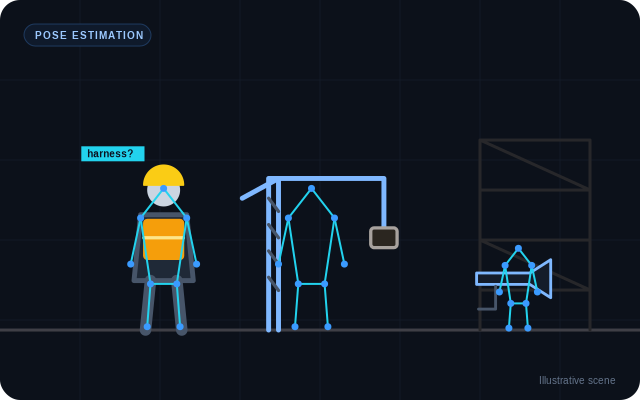
What can be checked
- People in elevated work zones
- Visible harness use
- People near unprotected edges
What the team receives
- Awareness alerts for supervisors
- Aggregated statistics per zone
What the solution does
Extra awareness
Highlights risky situations supervisors may not see.
Trend data
Shows where fall-protection issues recur.
Uses site cameras
Works with fixed or temporary site cameras.
The operational problem
Falls from height are among the most serious workplace risks, and supervisors cannot observe all elevated work continuously.
How visual intelligence helps
Cameras detect people in elevated zones and check for visible fall-protection equipment, alerting supervisors to situations that need attention.
Example visual workflow
- Cameras view elevated work areas.
- People and visible protective equipment are detected.
- Situations of concern trigger alerts.
- Safety teams review trends.
Illustrative workflow — the actual pipeline is designed for each site during the PoC.
Edge deployment considerations
Site Edge devices process video locally and send alerts and statistics only.
How the solution is built
AI capabilities
The AI tasks this use case combines.
- Attribute Recognition
Attribute recognition determines properties of an object found by a detector — color, type, state, whether a helmet or vest is worn, whether a door is open.
- Object Detection
Object detection finds and labels the objects in an image or video frame and marks each one with a bounding box.
Visual inputs
Cameras and imaging that typically supply the video.
- Drones & UAVs
Drones capture visual data where fixed cameras cannot reach — long perimeters, large sites, tall structures and remote assets.
- IP and Network Cameras
IP cameras stream digital video over standard networks and are the most common source for Edge AI video analytics.
Deployment options
General approaches to evaluate, not tested hardware. Specific hardware is selected and validated for each project during the PoC.
- Camera and VMS Integration
Most projects start with cameras that are already installed.
- Edge AI Hardware Sizing
Sizing Edge AI hardware means matching compute, memory, power and enclosure to the real workload — the number of streams, resolution, frame rate, models and latency targets — under the site's environmental and installation constraints.
- Edge Deployment Architectures
Edge-first means processing video at or near where it is captured.
- Hybrid Edge + Cloud Architecture
In a hybrid architecture, time-critical video analysis runs at the edge while selected functions — central dashboards, long-term storage, fleet management or model improvement — run in the Cloud.
Practical factors to plan for
Real-world results depend as much on the environment and camera setup as on the model.
Site and setup
- Visibility. Harness straps and lanyards are small and may be hidden.
- Zones. Elevated work zones must be defined per camera.
Human review
Supervisors verify alerts and address situations according to site procedures. Not a disciplinary tool.
Limitations & scope
- Harness detection from a distance is challenging.
- Does not verify that equipment is correctly anchored.
Proof of Concept
Have a visual AI challenge? Let's prove it.
Share a video of what happens in your environment and describe the outcome you need. We review every request for technical feasibility, then agree the scope of a focused Proof of Concept (PoC) with you.
Example request: “We want alerts when people are on our warehouse roof without a visible harness.”
Every request is reviewed for technical feasibility. PoC scope, timing and terms are agreed individually.
Related topics
How this page connects to industries, use cases, AI tasks, input sources and deployment options.