Use CaseExcavators, cranes and trucks at work
Heavy Equipment Utilization Tracking
Detect excavators, loaders, cranes and haul trucks on sites and classify whether they are working, idle or moving, giving project and fleet managers objective utilization data.
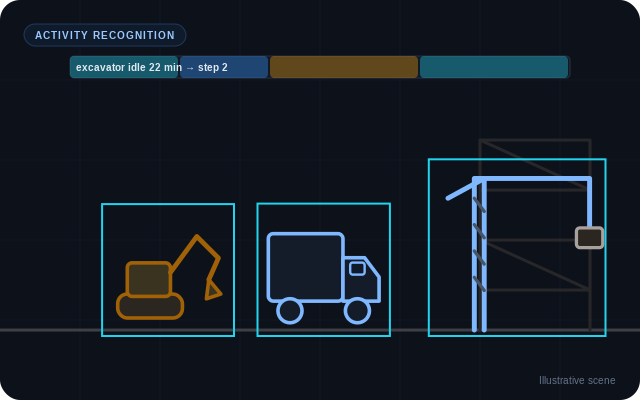
What can be checked
- Excavators loaders cranes and trucks
- Working idle and moving states
- Equipment entering and leaving zones
What the team receives
- Utilization timelines per machine type
- Idle-time reports
What the solution does
Objective utilization
Measures working, idle and absent time per machine from site cameras, showing how equipment is actually used across shifts.
Idle reduction
Highlights extended idle and waiting periods, which helps managers reassign machines or return rented equipment earlier.
Mixed fleets
Covers rented machines without telematics.
The operational problem
Equipment costs are high, but utilization is often unknown, especially for rented machines without telematics.
How visual intelligence helps
Cameras detect machines and classify whether they are working, idle or moving, producing utilization timelines and idle-time reports.
Example visual workflow
- Site cameras view work areas.
- Machines are detected and tracked.
- Activity states are classified over time.
- Utilization reports are produced.
Illustrative workflow — the actual pipeline is designed for each site during the PoC.
Edge deployment considerations
Site Edge devices process video locally and send only activity data over limited site connectivity.
How the solution is built
AI capabilities
The AI tasks this use case combines.
- Action and Activity Recognition
Action recognition identifies short actions — picking, lifting, opening a door — while activity recognition describes longer sequences such as a loading operation or a procedure.
- Object Detection
Object detection finds and labels the objects in an image or video frame and marks each one with a bounding box.
Visual inputs
Cameras and imaging that typically supply the video.
- Drones & UAVs
Drones capture visual data where fixed cameras cannot reach — long perimeters, large sites, tall structures and remote assets.
- IP and Network Cameras
IP cameras stream digital video over standard networks and are the most common source for Edge AI video analytics.
Deployment options
General approaches to evaluate, not tested hardware. Specific hardware is selected and validated for each project during the PoC.
- Camera and VMS Integration
Most projects start with cameras that are already installed.
- Edge AI Hardware Sizing
Sizing Edge AI hardware means matching compute, memory, power and enclosure to the real workload — the number of streams, resolution, frame rate, models and latency targets — under the site's environmental and installation constraints.
- Edge Deployment Architectures
Edge-first means processing video at or near where it is captured.
- Hybrid Edge + Cloud Architecture
In a hybrid architecture, time-critical video analysis runs at the edge while selected functions — central dashboards, long-term storage, fleet management or model improvement — run in the Cloud.
Practical factors to plan for
Real-world results depend as much on the environment and camera setup as on the model.
Site and setup
- Activity definitions. Working versus idle must be defined per machine type.
- Changing sites. Camera views must follow the evolving site.
Human review
Managers interpret utilization data alongside telematics and site plans.
Limitations & scope
- Machines hidden behind structures are not observed.
- Activity classification is approximate for complex tasks.
Proof of Concept
Have a visual AI challenge? Let's prove it.
Share a video of what happens in your environment and describe the outcome you need. We review every request for technical feasibility, then agree the scope of a focused Proof of Concept (PoC) with you.
Example request: “We want working and idle time per excavator on our earthworks site from two mast cameras.”
Every request is reviewed for technical feasibility. PoC scope, timing and terms are agreed individually.
Related topics
How this page connects to industries, use cases, AI tasks, input sources and deployment options.