Use CaseFalls and motionless workers in industrial areas
Man-Down and Worker Fall Detection
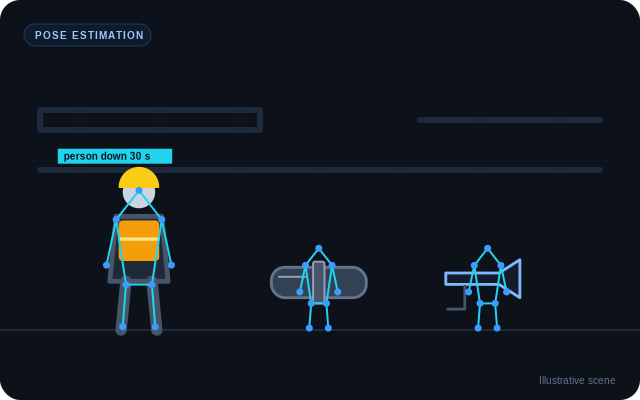
Detect workers who fall or remain motionless on the ground in plants, warehouses and remote areas, giving supervisors faster awareness — especially for lone workers and night shifts.
What can be checked
- Falls from standing or walking
- Persons lying on the ground
- Lack of movement over a defined time
What the team receives
- Alerts with snapshot and location
- Event history for safety reviews
What the solution does
Faster awareness
Notices falls that nobody else witnessed.
Lone-worker support
Adds visual awareness for remote and night-shift areas.
Safety insight
Shows where falls and slips happen most often.
The operational problem
Workers who fall or collapse in remote or lightly staffed areas may not be found quickly. Lone-worker devices help, but not everyone wears them correctly at all times.
How visual intelligence helps
Pose estimation and activity recognition identify falls and people lying motionless. Alerts with snapshots go to supervisors, who verify the situation and respond.
Example visual workflow
- Cameras observe work areas and walkways.
- People are detected and their posture estimated.
- Falls and motionless persons beyond a threshold create alerts.
- Supervisors verify and respond.
Illustrative workflow — the actual pipeline is designed for each site during the PoC.
Edge deployment considerations
Processing runs on Edge devices on site so alerts do not depend on wide-area links, and video can remain local.
How the solution is built
AI capabilities
The AI tasks this use case combines.
- Action and Activity Recognition
Action recognition identifies short actions — picking, lifting, opening a door — while activity recognition describes longer sequences such as a loading operation or a procedure.
- Pose Estimation
Pose estimation locates keypoints — such as shoulders, elbows, knees or the corners of an object — and connects them into a skeleton or structure.
Visual inputs
Cameras and imaging that typically supply the video.
- IP and Network Cameras
IP cameras stream digital video over standard networks and are the most common source for Edge AI video analytics.
- Thermal and Infrared Cameras
Thermal cameras image heat (long-wave infrared), while near-infrared cameras use invisible illumination to see in darkness.
Deployment options
General approaches to evaluate, not tested hardware. Specific hardware is selected and validated for each project during the PoC.
- Camera and VMS Integration
Most projects start with cameras that are already installed.
- Edge AI Hardware Sizing
Sizing Edge AI hardware means matching compute, memory, power and enclosure to the real workload — the number of streams, resolution, frame rate, models and latency targets — under the site's environmental and installation constraints.
- Edge Deployment Architectures
Edge-first means processing video at or near where it is captured.
- Industrial and Ruggedized Edge AI Computers
Industrial Edge AI computers and ruggedized systems house AI-capable processors in enclosures built for factories, vehicles and outdoor sites — wide temperature ranges, vibration, dust and industrial power.
Practical factors to plan for
Real-world results depend as much on the environment and camera setup as on the model.
Site and setup
- Time thresholds. Short thresholds speed up alerts but raise false alarms from kneeling or lying work.
- Coverage. Remote corners and stairwells need camera coverage to be included.
Human review
Supervisors verify alerts by video or radio before responding. The system complements lone-worker devices and emergency procedures.
Limitations & scope
- Normal work that involves kneeling or lying can resemble a fall.
- Occluded areas and poor lighting reduce detection reliability.
Proof of Concept
Have a visual AI challenge? Let's prove it.
Share a video of what happens in your environment and describe the outcome you need. We review every request for technical feasibility, then agree the scope of a focused Proof of Concept (PoC) with you.
Example request: “We want alerts when someone lies motionless for more than 30 seconds in our pump houses during night shifts.”
Every request is reviewed for technical feasibility. PoC scope, timing and terms are agreed individually.
Related topics
How this page connects to industries, use cases, AI tasks, input sources and deployment options.