Use CaseConductors, insulators and towers
Power Line Inspection
Analyze drone or helicopter imagery of power lines to highlight possible damaged insulators, missing components, conductor damage and tower issues.
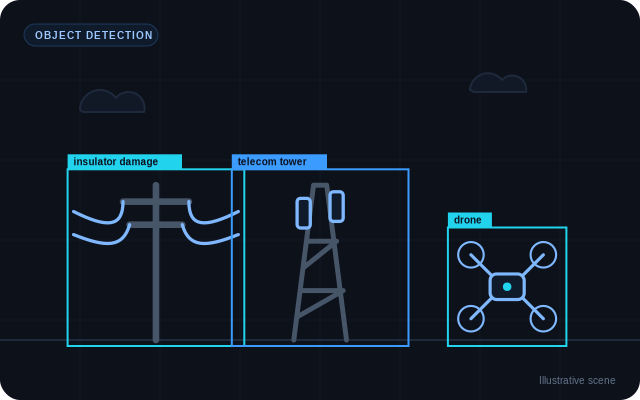
What can be checked
- Broken or flashed insulators
- Missing or damaged components
- Conductor and tower damage
What the team receives
- Findings with asset IDs
- Inspection reports
What the solution does
Faster review
Screens large aerial image sets so engineers review findings, not every image.
Asset linkage
Ties every finding to its tower or span for maintenance planning.
Consistent results
Applies the same detection criteria across lines and inspection campaigns.
The operational problem
Power line inspections produce very large image sets, and manually reviewing them is slow and inconsistent.
How visual intelligence helps
Models detect insulators, fittings and conductors and highlight visible defects. Findings are linked to towers and spans for engineer review.
Example visual workflow
- Aerial imagery is captured along the line.
- Components are detected and analyzed.
- Findings are linked to assets.
- Engineers review and plan work.
Illustrative workflow — the actual pipeline is designed for each site during the PoC.
Edge deployment considerations
Processing can run in the field during inspection campaigns or in the Cloud, depending on data volume.
How the solution is built
AI capabilities
The AI tasks this use case combines.
- Defect Detection
Defect detection locates and classifies specific, known defect types — scratches, cracks, dents, contamination, missing features — in images of products or assets.
- Object Detection
Object detection finds and labels the objects in an image or video frame and marks each one with a bounding box.
Visual inputs
Cameras and imaging that typically supply the video.
- Drones & UAVs
Drones capture visual data where fixed cameras cannot reach — long perimeters, large sites, tall structures and remote assets.
- Thermal and Infrared Cameras
Thermal cameras image heat (long-wave infrared), while near-infrared cameras use invisible illumination to see in darkness.
Deployment options
General approaches to evaluate, not tested hardware. Specific hardware is selected and validated for each project during the PoC.
- Edge AI Hardware Sizing
Sizing Edge AI hardware means matching compute, memory, power and enclosure to the real workload — the number of streams, resolution, frame rate, models and latency targets — under the site's environmental and installation constraints.
- Edge Deployment Architectures
Edge-first means processing video at or near where it is captured.
- Hybrid Edge + Cloud Architecture
In a hybrid architecture, time-critical video analysis runs at the edge while selected functions — central dashboards, long-term storage, fleet management or model improvement — run in the Cloud.
- Industrial and Ruggedized Edge AI Computers
Industrial Edge AI computers and ruggedized systems house AI-capable processors in enclosures built for factories, vehicles and outdoor sites — wide temperature ranges, vibration, dust and industrial power.
Practical factors to plan for
Real-world results depend as much on the environment and camera setup as on the model.
Site and setup
- Asset matching. Findings must be matched to towers and spans.
- Image volume. Line inspections create very large datasets.
Human review
Line engineers review findings and plan maintenance.
Limitations & scope
- Small defects need close imagery.
- Live-line work remains with qualified staff.
Proof of Concept
Have a visual AI challenge? Let's prove it.
Share a video of what happens in your environment and describe the outcome you need. We review every request for technical feasibility, then agree the scope of a focused Proof of Concept (PoC) with you.
Example request: “We want to flag damaged insulators in drone imagery of our 33 kV lines.”
Every request is reviewed for technical feasibility. PoC scope, timing and terms are agreed individually.
Related topics
How this page connects to industries, use cases, AI tasks, input sources and deployment options.