Use CaseProducts, surfaces and assemblies
Quality Inspection and Defect Detection
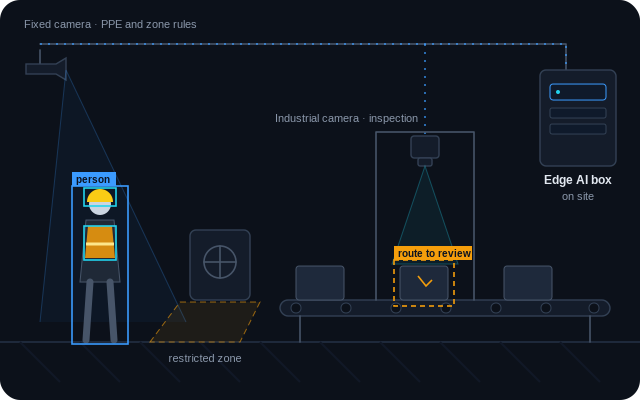
Inspect products, surfaces and assemblies with cameras and Edge AI to flag possible defects, deviations or missing features — every unit rather than samples, with decisions made at the line.
What can be checked
- Surface defects such as scratches, dents, stains, cracks or discoloration
- Missing, extra or misplaced components in assemblies
- Shape, size or color deviations against the expected product
- Packaging defects such as damaged, open or mislabeled units
What the team receives
- Pass, fail or review decisions per unit, with the image and defect location
- Signals to reject mechanisms or line controllers where integrated
- Defect statistics by type, shift and product
What the solution does
Checks every unit
Applies consistent inspection criteria to every unit instead of periodic samples.
Locates the defect
Shows where on the part the possible defect is, so inspectors can confirm quickly.
Decides at the line
Runs on Edge hardware next to the line so results arrive in time to reject or divert a unit.
The problem
Manual visual inspection is repetitive, and results vary between inspectors and over long shifts. Rule-based machine vision handles fixed, well-defined checks but struggles with variable defects and natural variation. Edge AI inspection helps where defects vary in appearance but are still visible.
How visual intelligence helps
Depending on the defect, inspection uses classification (good or defective), detection or segmentation (where the defect is), or anomaly detection (what differs from normal). Defect detection is treated as an AI task; quality inspection is the business use case that combines it with lighting, rejection logic and reporting.
Deployment considerations
Inspection runs at the edge because decisions must be made within the line’s cycle time. A typical setup is an industrial camera with controlled lighting connected to an industrial Edge AI computer.
How the solution is built
AI capabilities
The AI tasks this use case combines.
- Defect Detection
Defect detection locates and classifies specific, known defect types — scratches, cracks, dents, contamination, missing features — in images of products or assets.
- Image and Object Classification
Classification assigns a label to a whole image or to an individual object crop — good or defective, running or stopped, product variant A or B.
- Instance Segmentation
Instance segmentation detects each object and outlines its exact pixels — a separate mask per object.
- Visual Anomaly Detection
Visual anomaly detection learns what normal looks like and flags images, regions or events that deviate from it.
Visual inputs
Cameras and imaging that typically supply the video.
- Depth, Stereo and 3D Cameras
Depth cameras measure distance to every point in view, using stereo vision, structured light or time-of-flight.
- High-Speed Cameras
High-speed cameras capture hundreds or thousands of frames per second, revealing events too fast for standard cameras — on fast packaging lines, in machinery or in process analysis.
- Industrial and Machine Vision Cameras
Industrial and machine vision cameras capture sharp, consistent images at fixed positions with controlled lighting and triggering.
Deployment options
General approaches to evaluate, not tested hardware. Specific hardware is selected and validated for each project during the PoC.
- Edge AI Hardware Sizing
Sizing Edge AI hardware means matching compute, memory, power and enclosure to the real workload — the number of streams, resolution, frame rate, models and latency targets — under the site's environmental and installation constraints.
- Edge Deployment Architectures
Edge-first means processing video at or near where it is captured.
- Industrial and Ruggedized Edge AI Computers
Industrial Edge AI computers and ruggedized systems house AI-capable processors in enclosures built for factories, vehicles and outdoor sites — wide temperature ranges, vibration, dust and industrial power.
Practical factors to plan for
Real-world results depend as much on the environment and camera setup as on the model.
Site and setup
- Lighting and optics. Consistent lighting and fixed camera geometry often matter more than the model. Many defects only become visible under a specific lighting setup.
- Defect definitions. Defect classes and acceptance limits are agreed with quality staff, ideally with labeled examples of each.
- Rare defects. When defective examples are rare, anomaly-detection approaches trained on good parts can complement supervised detection.
- Cycle time. Model, resolution and hardware are sized together to keep up with line speed.
Human review
Uncertain or borderline cases are routed to qualified inspectors. Acceptance criteria and release decisions remain with your quality system.
Limitations & scope
- Detection is limited to defects that are visible under the installed lighting and camera setup.
- Performance is measured against agreed defect classes on samples from your process; new defect types need re-evaluation.
- Inspection systems used in regulated industries require validation as a separate activity.
Proof of Concept
Have a visual AI challenge? Let's prove it.
Share a video of what happens in your environment and describe the outcome you need. We review every request for technical feasibility, then agree the scope of a focused Proof of Concept (PoC) with you.
Example request: “We want to flag molded parts with surface scratches before they are packed.”
Every request is reviewed for technical feasibility. PoC scope, timing and terms are agreed individually.
Frequently asked questions
How many defect examples are needed?
It depends on the defect variety. Some approaches need many labeled examples; anomaly detection can start from good parts only. The approach is chosen during the PoC based on what data exists.
Can existing CCTV be used for inspection?
Rarely for fine defects. Inline inspection usually needs industrial cameras with controlled lighting at a fixed distance.
Related topics
How this page connects to industries, use cases, AI tasks, input sources and deployment options.