Use CaseFlows, speeds and incidents
Traffic Monitoring
Monitor traffic flows on roads, junctions, site roads and yards — volumes, movements, congestion and incidents such as stopped vehicles or wrong-way driving — with video analyzed at the roadside.
What can be checked
- Vehicle flows and turning movements at junctions
- Congestion and queue formation
- Stopped vehicles, wrong-way movement and obstructions
- Pedestrians and cyclists in shared spaces
What the team receives
- Flow and turning-movement counts per interval
- Incident alerts with snapshot for operators
- Congestion and travel-pattern reports
What the solution does
Turning movements
Tracks vehicles through junctions to count movements by origin and destination.
Incident awareness
Flags stopped vehicles, wrong-way driving or obstructions for operators.
Roadside processing
Analyzes video at or near the camera so only data and alerts are transmitted.
The problem
Traffic data is often collected through temporary surveys or limited detectors. Incidents are spotted by operators watching many screens, or reported late by road users.
How visual intelligence helps
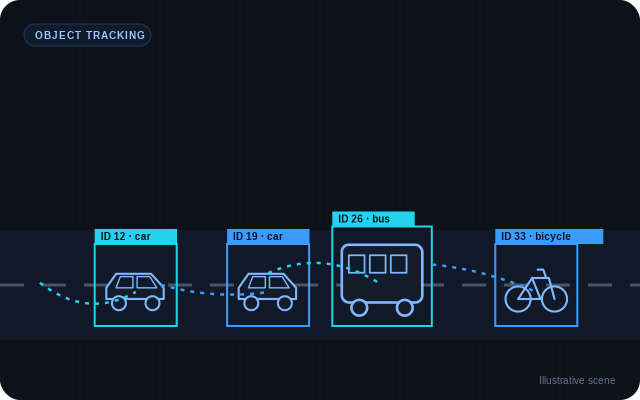
Detection and multi-object tracking follow vehicles, cyclists and pedestrians through a scene. Counting and rules convert trajectories into flows, turning movements and incident events.
Deployment considerations
Roadside Edge processing reduces bandwidth and supports privacy by sending data rather than video; central platforms combine results across locations.
How the solution is built
AI capabilities
The AI tasks this use case combines.
- Counting and Measurement
Counting and measurement convert detections, tracks and masks into quantities — how many objects, how long they stayed, how big they are, how full an area is.
- Object Detection
Object detection finds and labels the objects in an image or video frame and marks each one with a bounding box.
- Object Tracking and Multi-Object Tracking
Object tracking links detections of the same object across consecutive video frames and assigns each one a persistent ID.
- Visual Anomaly Detection
Visual anomaly detection learns what normal looks like and flags images, regions or events that deviate from it.
Visual inputs
Cameras and imaging that typically supply the video.
- CCTV and Existing Surveillance Systems
Many sites already run CCTV systems — analog cameras, DVRs, NVRs and video management systems.
- IP and Network Cameras
IP cameras stream digital video over standard networks and are the most common source for Edge AI video analytics.
- Vehicle-Mounted Cameras
Cameras on trucks, rail vehicles, forklifts, buses and service vehicles capture visual data while moving — for road and rail inspection, operational safety and fleet operations.
Deployment options
General approaches to evaluate, not tested hardware. Specific hardware is selected and validated for each project during the PoC.
- Camera and VMS Integration
Most projects start with cameras that are already installed.
- Edge AI Hardware Sizing
Sizing Edge AI hardware means matching compute, memory, power and enclosure to the real workload — the number of streams, resolution, frame rate, models and latency targets — under the site's environmental and installation constraints.
- Edge Deployment Architectures
Edge-first means processing video at or near where it is captured.
- Standalone Edge AI Devices
Standalone Edge AI devices are compact, self-contained units — AI boxes or smart cameras — that process video locally at a single location.
Practical factors to plan for
Real-world results depend as much on the environment and camera setup as on the model.
Site and setup
- Camera geometry. Elevated views covering the full junction or road section give the best results for movement analysis.
- Speed estimation. Speeds can be estimated with calibration, but enforcement-grade measurement requires certified equipment.
- Conditions. Night, rain, glare and headlight reflections affect reliability and must be evaluated.
Human review
Incident alerts are verified by operators before response. Data used for planning is validated against reference counts.
Limitations & scope
- Estimated speeds are not suitable for enforcement without certified equipment and procedures.
- Public road deployments may be subject to specific standards and authority approvals.
- Number-plate recognition is not implied and has separate legal requirements.
Proof of Concept
Have a visual AI challenge? Let's prove it.
Share a video of what happens in your environment and describe the outcome you need. We review every request for technical feasibility, then agree the scope of a focused Proof of Concept (PoC) with you.
Example request: “We want turning-movement counts for a busy junction near our logistics hub, by vehicle class.”
Every request is reviewed for technical feasibility. PoC scope, timing and terms are agreed individually.
Frequently asked questions
Can existing traffic cameras be used?
Often. PTZ cameras that move frequently complicate analysis; fixed or preset positions work best.
Is this the same as vehicle counting?
Vehicle counting is one output. Traffic monitoring adds movements through junctions, congestion and incidents.
Related topics
How this page connects to industries, use cases, AI tasks, input sources and deployment options.