Use CaseRust and coating damage on assets
Corrosion Detection
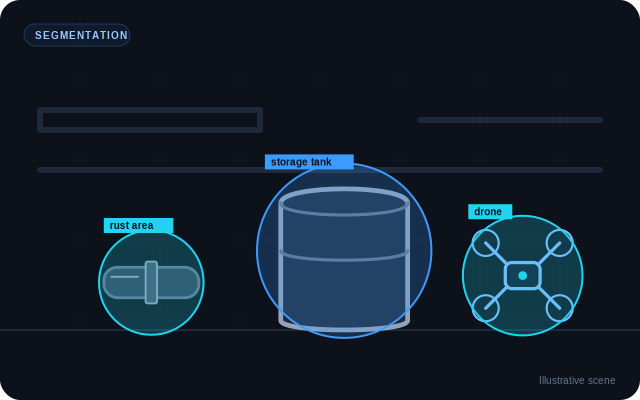
Highlight visible corrosion, rust and coating damage on structures, pipes, tanks and towers in drone, robot or handheld imagery to help prioritize maintenance.
What can be checked
- Rust and visible corrosion
- Coating breakdown and blistering
- Corrosion around joints and fasteners
What the team receives
- Segmented corrosion areas per image
- Severity ranking for maintenance planning
What the solution does
Faster review
Reduces time spent screening large image sets.
Comparable results
Supports consistent severity grading over time.
Asset linkage
Ties findings to asset IDs and locations.
The operational problem
Asset owners collect large volumes of inspection imagery but reviewing it for corrosion is slow and subjective.
How visual intelligence helps
Segmentation models highlight corrosion areas and rank them, so engineers review prioritized findings instead of every image.
Example visual workflow
- Imagery is captured by drone or robot or by an inspector.
- Models segment visible corrosion and coating damage.
- Findings are ranked and linked to asset locations.
- Engineers review and plan maintenance.
Illustrative workflow — the actual pipeline is designed for each site during the PoC.
Edge deployment considerations
Analysis may run on a ground station during inspection campaigns or on site servers; Cloud processing can support portfolio-wide analysis.
How the solution is built
AI capabilities
The AI tasks this use case combines.
- Defect Detection
Defect detection locates and classifies specific, known defect types — scratches, cracks, dents, contamination, missing features — in images of products or assets.
- Semantic Segmentation
Semantic segmentation assigns a class to every pixel of an image — road, floor, water, smoke, crop, background — producing a map of regions rather than individual objects.
Visual inputs
Cameras and imaging that typically supply the video.
- Drones & UAVs
Drones capture visual data where fixed cameras cannot reach — long perimeters, large sites, tall structures and remote assets.
- Mobile Device Cameras
Smartphones and tablets put capable cameras and processors in the hands of field teams.
- Robotic Vision
Robotic vision places cameras on or around robot arms to guide picking, placement, assembly and inspection.
Deployment options
General approaches to evaluate, not tested hardware. Specific hardware is selected and validated for each project during the PoC.
- Edge AI Hardware Sizing
Sizing Edge AI hardware means matching compute, memory, power and enclosure to the real workload — the number of streams, resolution, frame rate, models and latency targets — under the site's environmental and installation constraints.
- Edge Deployment Architectures
Edge-first means processing video at or near where it is captured.
- Hybrid Edge + Cloud Architecture
In a hybrid architecture, time-critical video analysis runs at the edge while selected functions — central dashboards, long-term storage, fleet management or model improvement — run in the Cloud.
- Industrial and Ruggedized Edge AI Computers
Industrial Edge AI computers and ruggedized systems house AI-capable processors in enclosures built for factories, vehicles and outdoor sites — wide temperature ranges, vibration, dust and industrial power.
- Standalone Edge AI Devices
Standalone Edge AI devices are compact, self-contained units — AI boxes or smart cameras — that process video locally at a single location.
Practical factors to plan for
Real-world results depend as much on the environment and camera setup as on the model.
Site and setup
- Image distance. Assessment needs consistent capture distance or scale references.
- Severity scale. Ranking must follow the owner's inspection standard.
Human review
Integrity engineers review results and determine repair priorities.
Limitations & scope
- Visual inspection cannot measure wall thickness or internal corrosion.
- Dirt and staining may resemble corrosion.
Proof of Concept
Have a visual AI challenge? Let's prove it.
Share a video of what happens in your environment and describe the outcome you need. We review every request for technical feasibility, then agree the scope of a focused Proof of Concept (PoC) with you.
Example request: “We want to segment visible rust on tank shells from our drone inspection images.”
Every request is reviewed for technical feasibility. PoC scope, timing and terms are agreed individually.
Related topics
How this page connects to industries, use cases, AI tasks, input sources and deployment options.