Use CaseVisible condition and state of machines
Equipment Monitoring
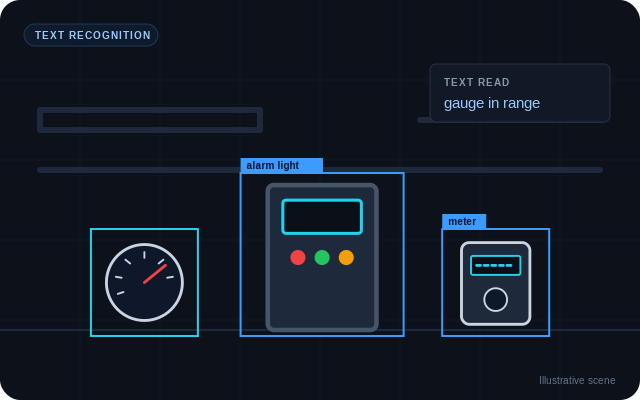
Use cameras to monitor the visible state and condition of equipment — indicator lights, gauges, moving parts, leaks or heat signatures — where adding sensors is impractical, with analysis at the edge.
What can be checked
- Running, idle or stopped state of machines
- Readings of analog gauges, counters and displays
- Status of indicator lights and stack lights
- Visible leaks, smoke, vibration or unusual movement
- Thermal anomalies where thermal cameras are used
What the team receives
- State changes and readings as time series
- Alerts when readings leave defined ranges
- Utilization and downtime statistics
What the solution does
Digitizes legacy equipment
Turns gauges, counters and lights that are read manually into data without rewiring equipment.
Watches many indicators at once
One camera can observe several gauges or machines within its view.
Runs on site
Processes images locally so readings and alerts stay on the plant network.
The problem
Many plants still rely on people walking past machines to read gauges and check lights. Retrofitting sensors on legacy equipment is often expensive or not permitted. Cameras can observe these indicators continuously.
How visual intelligence helps
Classification determines states such as running or stopped, OCR and custom models read gauges and displays, and anomaly detection highlights unusual visual or thermal patterns. Results become time series and alerts.
Deployment considerations
Edge processing on the plant network keeps readings local and supports integration with existing maintenance or SCADA systems.
How the solution is built
AI capabilities
The AI tasks this use case combines.
- Image and Object Classification
Classification assigns a label to a whole image or to an individual object crop — good or defective, running or stopped, product variant A or B.
- OCR and Text Recognition
Optical character recognition (OCR) reads text visible in images — labels, codes, container numbers, displays and gauges.
- Visual Anomaly Detection
Visual anomaly detection learns what normal looks like and flags images, regions or events that deviate from it.
Visual inputs
Cameras and imaging that typically supply the video.
- Industrial and Machine Vision Cameras
Industrial and machine vision cameras capture sharp, consistent images at fixed positions with controlled lighting and triggering.
- IP and Network Cameras
IP cameras stream digital video over standard networks and are the most common source for Edge AI video analytics.
- Thermal and Infrared Cameras
Thermal cameras image heat (long-wave infrared), while near-infrared cameras use invisible illumination to see in darkness.
Deployment options
General approaches to evaluate, not tested hardware. Specific hardware is selected and validated for each project during the PoC.
- Camera and VMS Integration
Most projects start with cameras that are already installed.
- Edge AI Hardware Sizing
Sizing Edge AI hardware means matching compute, memory, power and enclosure to the real workload — the number of streams, resolution, frame rate, models and latency targets — under the site's environmental and installation constraints.
- Edge Deployment Architectures
Edge-first means processing video at or near where it is captured.
- Industrial and Ruggedized Edge AI Computers
Industrial Edge AI computers and ruggedized systems house AI-capable processors in enclosures built for factories, vehicles and outdoor sites — wide temperature ranges, vibration, dust and industrial power.
Practical factors to plan for
Real-world results depend as much on the environment and camera setup as on the model.
Site and setup
- Clear line of sight. Gauges and indicators must be visible without obstruction, glare or reflections from the camera position.
- Reading precision. The precision achievable for gauge reading depends on dial design, resolution and angle.
- Retrofit versus sensors. Video is most useful where sensors are costly to retrofit or many legacy indicators exist.
Human review
Readings and alerts are reviewed by operations or maintenance staff before action, and cross-checked against telemetry where available.
Limitations & scope
- Video observes only what is visible; internal faults without visible symptoms are not detected.
- Readings are approximations and must be validated per instrument.
- Video monitoring complements, but does not replace, safety instrumentation and condition-monitoring sensors.
Proof of Concept
Have a visual AI challenge? Let's prove it.
Share a video of what happens in your environment and describe the outcome you need. We review every request for technical feasibility, then agree the scope of a focused Proof of Concept (PoC) with you.
Example request: “We want to record when the red stack light on each of our six presses turns on, and for how long.”
Every request is reviewed for technical feasibility. PoC scope, timing and terms are agreed individually.
Frequently asked questions
How often can a gauge be read?
As often as the camera provides frames, but many applications only need a reading every few seconds or minutes, which reduces compute needs.
Can thermal cameras be included?
Yes. Thermal imaging can reveal heat patterns on motors, bearings and electrical equipment, which can be monitored for change over time.
Related topics
How this page connects to industries, use cases, AI tasks, input sources and deployment options.