Use CaseVisual early awareness
Fire and Smoke Detection
Flag visible smoke, flame or abnormal heat in camera views of production halls, storage areas, outdoor sites and forests as an early visual awareness layer — complementing, never replacing, certified fire detection.
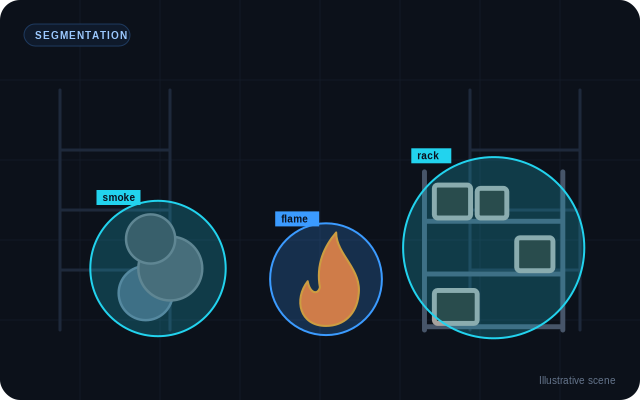
What can be checked
- Visible smoke plumes and haze
- Visible flames
- Abnormal heat patterns where thermal cameras are used
What the team receives
- Alerts with snapshot or clip for verification
- Event history by camera and area
What the solution does
Covers open and large spaces
Visual analysis can observe large halls, yards and outdoor areas where ceiling detectors are less effective.
Uses existing cameras
Many existing camera views can be evaluated for smoke and flame awareness.
Fast local alerts
Processes video on site so alerts do not depend on remote connectivity.
The problem
Fires often start small and visible. In large halls, yards and outdoor sites, conventional detectors may respond late. Cameras already watch many of these areas.
How visual intelligence helps
Detection and segmentation models trained on smoke and flame appearance flag possible events; thermal analysis adds heat-based cues. Each alert includes imagery so a person can verify quickly.
Deployment considerations
Processing at the edge keeps alerts independent of network availability and avoids streaming video continuously.
How the solution is built
AI capabilities
The AI tasks this use case combines.
- Image and Object Classification
Classification assigns a label to a whole image or to an individual object crop — good or defective, running or stopped, product variant A or B.
- Object Detection
Object detection finds and labels the objects in an image or video frame and marks each one with a bounding box.
- Semantic Segmentation
Semantic segmentation assigns a class to every pixel of an image — road, floor, water, smoke, crop, background — producing a map of regions rather than individual objects.
Visual inputs
Cameras and imaging that typically supply the video.
- Drones & UAVs
Drones capture visual data where fixed cameras cannot reach — long perimeters, large sites, tall structures and remote assets.
- IP and Network Cameras
IP cameras stream digital video over standard networks and are the most common source for Edge AI video analytics.
- Thermal and Infrared Cameras
Thermal cameras image heat (long-wave infrared), while near-infrared cameras use invisible illumination to see in darkness.
Deployment options
General approaches to evaluate, not tested hardware. Specific hardware is selected and validated for each project during the PoC.
- Camera and VMS Integration
Most projects start with cameras that are already installed.
- Edge AI Hardware Sizing
Sizing Edge AI hardware means matching compute, memory, power and enclosure to the real workload — the number of streams, resolution, frame rate, models and latency targets — under the site's environmental and installation constraints.
- Edge Deployment Architectures
Edge-first means processing video at or near where it is captured.
- Hybrid Edge + Cloud Architecture
In a hybrid architecture, time-critical video analysis runs at the edge while selected functions — central dashboards, long-term storage, fleet management or model improvement — run in the Cloud.
- Industrial and Ruggedized Edge AI Computers
Industrial Edge AI computers and ruggedized systems house AI-capable processors in enclosures built for factories, vehicles and outdoor sites — wide temperature ranges, vibration, dust and industrial power.
Practical factors to plan for
Real-world results depend as much on the environment and camera setup as on the model.
Site and setup
- Look-alikes. Steam, dust, fog, exhaust and reflections can resemble smoke or flame; evaluation footage should include them.
- Scene distance. Smoke must occupy enough of the image to be detected; large open areas may need closer or more cameras.
- Thermal complement. Thermal cameras detect heat before visible smoke in some scenarios, and help at night.
Human review
Every alert is verified by a person before response. The system is an awareness aid and does not trigger suppression or evacuation on its own.
Limitations & scope
- Visual fire and smoke detection is not a certified fire detection system and must not replace one.
- Performance depends on view, lighting, distance and look-alike phenomena; some events will be missed or falsely flagged.
- Integration with fire alarm systems must follow applicable standards and authority requirements.
Proof of Concept
Have a visual AI challenge? Let's prove it.
Share a video of what happens in your environment and describe the outcome you need. We review every request for technical feasibility, then agree the scope of a focused Proof of Concept (PoC) with you.
Example request: “We want an early visual alert for smoke in a large storage hall that already has certified detectors.”
Every request is reviewed for technical feasibility. PoC scope, timing and terms are agreed individually.
Frequently asked questions
Can this replace smoke detectors?
No. Certified fire detection and alarm systems remain required. Visual detection adds awareness, particularly in large or outdoor areas.
Does it work outdoors?
It can, for example for smoke on industrial sites or wildland areas, but weather and distance must be evaluated carefully.
Related topics
How this page connects to industries, use cases, AI tasks, input sources and deployment options.