Use CaseStock levels you can see
Inventory Monitoring
Use fixed or mobile cameras to estimate stock levels, empty locations and misplaced items on shelves, racks and storage areas — complementing inventory systems with what is physically there.
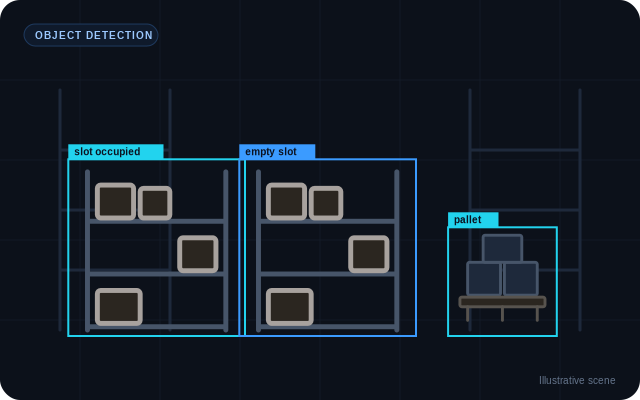
What can be checked
- Empty or occupied pallet positions and bin locations
- Gaps and low stock on shelves
- Items placed in unexpected locations
- Visible labels, where legible, to confirm location contents
What the team receives
- Occupancy maps of storage locations
- Low-stock and gap alerts
- Discrepancy lists for cycle counting
What the solution does
Shows physical reality
Reveals what is actually on the shelf or rack, compared with what the system expects.
Targets cycle counts
Directs counting effort to locations with likely discrepancies.
Fixed or mobile capture
Works with fixed cameras or periodic capture from mobile robots and vehicles.
The problem
Inventory records drift from physical reality through misplacement, unrecorded movements and errors. Full counts are disruptive; cycle counts are only as good as their targeting.
How visual intelligence helps
Detection and classification identify occupied or empty locations and products; OCR confirms labels where legible; counting estimates quantities. Comparing results with system records creates targeted discrepancy lists.
Deployment considerations
Processing can happen on a mobile platform or on site, with results synchronized to inventory systems.
How the solution is built
AI capabilities
The AI tasks this use case combines.
- Counting and Measurement
Counting and measurement convert detections, tracks and masks into quantities — how many objects, how long they stayed, how big they are, how full an area is.
- Image and Object Classification
Classification assigns a label to a whole image or to an individual object crop — good or defective, running or stopped, product variant A or B.
- Object Detection
Object detection finds and labels the objects in an image or video frame and marks each one with a bounding box.
- OCR and Text Recognition
Optical character recognition (OCR) reads text visible in images — labels, codes, container numbers, displays and gauges.
Visual inputs
Cameras and imaging that typically supply the video.
- IP and Network Cameras
IP cameras stream digital video over standard networks and are the most common source for Edge AI video analytics.
- Mobile Robots and AMRs
Mobile robots — autonomous mobile robots (AMRs), quadrupeds and inspection robots — carry cameras through facilities and sites on repeatable routes.
- Vehicle-Mounted Cameras
Cameras on trucks, rail vehicles, forklifts, buses and service vehicles capture visual data while moving — for road and rail inspection, operational safety and fleet operations.
Deployment options
General approaches to evaluate, not tested hardware. Specific hardware is selected and validated for each project during the PoC.
- Camera and VMS Integration
Most projects start with cameras that are already installed.
- Edge AI Hardware Sizing
Sizing Edge AI hardware means matching compute, memory, power and enclosure to the real workload — the number of streams, resolution, frame rate, models and latency targets — under the site's environmental and installation constraints.
- Edge Deployment Architectures
Edge-first means processing video at or near where it is captured.
- Standalone Edge AI Devices
Standalone Edge AI devices are compact, self-contained units — AI boxes or smart cameras — that process video locally at a single location.
Practical factors to plan for
Real-world results depend as much on the environment and camera setup as on the model.
Site and setup
- Coverage strategy. Fixed cameras suit specific areas; robot- or vehicle-mounted cameras can cover whole aisles periodically.
- Viewing angle and resolution. Identifying items or reading labels on high racks requires sufficient resolution and suitable angles.
- Data matching. Comparing observations with WMS records requires a location map that links camera views to storage locations.
Human review
Discrepancies are reviewed by inventory staff and confirmed before records are corrected.
Limitations & scope
- Items hidden behind others or inside closed packaging cannot be counted from images.
- Video-based estimates complement inventory systems and are not themselves an accounting record.
- Performance depends strongly on layout, lighting and packaging; it is evaluated per facility.
Proof of Concept
Have a visual AI challenge? Let's prove it.
Share a video of what happens in your environment and describe the outcome you need. We review every request for technical feasibility, then agree the scope of a focused Proof of Concept (PoC) with you.
Example request: “We want a daily list of empty pallet positions in our high-bay racking, from a forklift-mounted camera.”
Every request is reviewed for technical feasibility. PoC scope, timing and terms are agreed individually.
Frequently asked questions
Can cameras count individual items on shelves?
Sometimes, when items are visible and distinguishable. Often it is more practical to estimate shelf fullness or location occupancy.
Do we need a robot to scan aisles?
Not necessarily. Fixed cameras cover many areas. Mobile capture helps when many racks must be covered without installing many cameras.
Related topics
How this page connects to industries, use cases, AI tasks, input sources and deployment options.