Use CaseOutdoor boundaries and approaches
Perimeter Monitoring and Intrusion Detection
Detect people or vehicles approaching or crossing site boundaries — fences, gates and remote perimeters — using visible-light and thermal cameras, with analysis at the edge to keep alerts fast and bandwidth low.
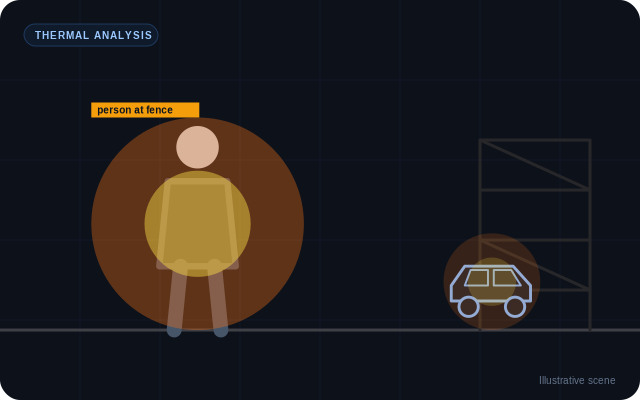
What can be checked
- People approaching or crossing a fence line or boundary
- Vehicles stopping or entering where not expected
- Activity at gates and remote access points outside expected times
- Loitering near the perimeter
What the team receives
- Alarm events with snapshot or short clip for verification
- Notifications to security operators or monitoring systems
- Event history and statistics by zone
What the solution does
Filters nuisance alarms
Distinguishes people and vehicles from animals, vegetation and weather better than simple motion detection.
Works at night
Combines visible and thermal cameras for detection in darkness.
Edge-first for remote sites
Analyzes video locally and sends only alarms and clips over limited links.
The problem
Simple motion detection on outdoor cameras triggers constantly on wind, animals and weather, so alarms get ignored. Long perimeters at remote sites cannot be watched continuously by people.
How visual intelligence helps
Object detection classifies what is moving — person, vehicle, animal — and tracking applies rules such as crossing a line or approaching a fence. Thermal imaging extends performance at night.
Deployment considerations
Perimeter analytics are a classic Edge application: processing at the camera or site keeps alarms fast and avoids streaming continuous video from remote locations.
How the solution is built
AI capabilities
The AI tasks this use case combines.
- Object Detection
Object detection finds and labels the objects in an image or video frame and marks each one with a bounding box.
- Object Tracking and Multi-Object Tracking
Object tracking links detections of the same object across consecutive video frames and assigns each one a persistent ID.
Visual inputs
Cameras and imaging that typically supply the video.
- Drones & UAVs
Drones capture visual data where fixed cameras cannot reach — long perimeters, large sites, tall structures and remote assets.
- IP and Network Cameras
IP cameras stream digital video over standard networks and are the most common source for Edge AI video analytics.
- Thermal and Infrared Cameras
Thermal cameras image heat (long-wave infrared), while near-infrared cameras use invisible illumination to see in darkness.
Deployment options
General approaches to evaluate, not tested hardware. Specific hardware is selected and validated for each project during the PoC.
- Camera and VMS Integration
Most projects start with cameras that are already installed.
- Edge AI Hardware Sizing
Sizing Edge AI hardware means matching compute, memory, power and enclosure to the real workload — the number of streams, resolution, frame rate, models and latency targets — under the site's environmental and installation constraints.
- Edge Deployment Architectures
Edge-first means processing video at or near where it is captured.
- Hybrid Edge + Cloud Architecture
In a hybrid architecture, time-critical video analysis runs at the edge while selected functions — central dashboards, long-term storage, fleet management or model improvement — run in the Cloud.
- Industrial and Ruggedized Edge AI Computers
Industrial Edge AI computers and ruggedized systems house AI-capable processors in enclosures built for factories, vehicles and outdoor sites — wide temperature ranges, vibration, dust and industrial power.
- Standalone Edge AI Devices
Standalone Edge AI devices are compact, self-contained units — AI boxes or smart cameras — that process video locally at a single location.
Practical factors to plan for
Real-world results depend as much on the environment and camera setup as on the model.
Site and setup
- Environmental nuisance. Animals, vegetation, rain, insects and headlights are the main sources of false alarms outdoors and must be represented in evaluation footage.
- Day and night. Thermal cameras extend detection range in darkness; visible cameras help operators verify what was detected.
- Distance and resolution. Detection range depends on lens, resolution and target size; long perimeters need careful camera spacing.
Human review
Alarms are verified by a security operator before response. The system detects and classifies objects; it does not identify individuals.
Limitations & scope
- No outdoor system detects every intrusion; performance varies with weather, terrain and camera placement.
- Detection does not physically prevent intrusion and supplements fences, barriers and security procedures.
- Monitoring of public areas beyond the site boundary must respect privacy law.
Proof of Concept
Have a visual AI challenge? Let's prove it.
Share a video of what happens in your environment and describe the outcome you need. We review every request for technical feasibility, then agree the scope of a focused Proof of Concept (PoC) with you.
Example request: “We want alerts for people approaching the fence of an unmanned substation at night, without alarms for animals.”
Every request is reviewed for technical feasibility. PoC scope, timing and terms are agreed individually.
Frequently asked questions
Do we need thermal cameras?
Not always. Well-lit perimeters may work with visible cameras. Thermal cameras improve night performance and detection range in many outdoor settings.
Can drones be used for perimeter patrol?
Drones can provide patrol or response imagery where regulations allow. Their footage can be analyzed onboard, on a nearby device or after the flight.
Related topics
How this page connects to industries, use cases, AI tasks, input sources and deployment options.
Industries
- Edge AI Video Intelligence for Agriculture
- Edge AI Video Intelligence for Airports
- Edge AI Video Intelligence for Construction
- Edge AI Video Intelligence for Energy
- Edge AI Video Intelligence for Environmental Monitoring
- Edge AI Video Intelligence for Infrastructure
- Edge AI Video Intelligence for Oil and Gas
- Edge AI Video Intelligence for Ports and Maritime
- Edge AI Video Intelligence for Telecommunications
- Edge AI Video Intelligence for Utilities